Li Yong | General Manager, Jeytop Industrial Group
I share practical insights on corrugated packaging machinery and production.
More Color Stations Do Not Automatically Mean a Better Press
When purchasing a corrugated flexo printer, many box plant managers start with a simple question:
“How many colors should I buy?”
The answer often starts from the wrong end. Many purchasing decisions begin with the machine’s maximum capability:
Is 6-color always better than 4-color?
Is 4-color more suitable for future development than 2-color?
Does more colors automatically mean greater machine capability?
From a machine design and manufacturing perspective, more color stations are not automatically better. A more reliable purchasing logic is:
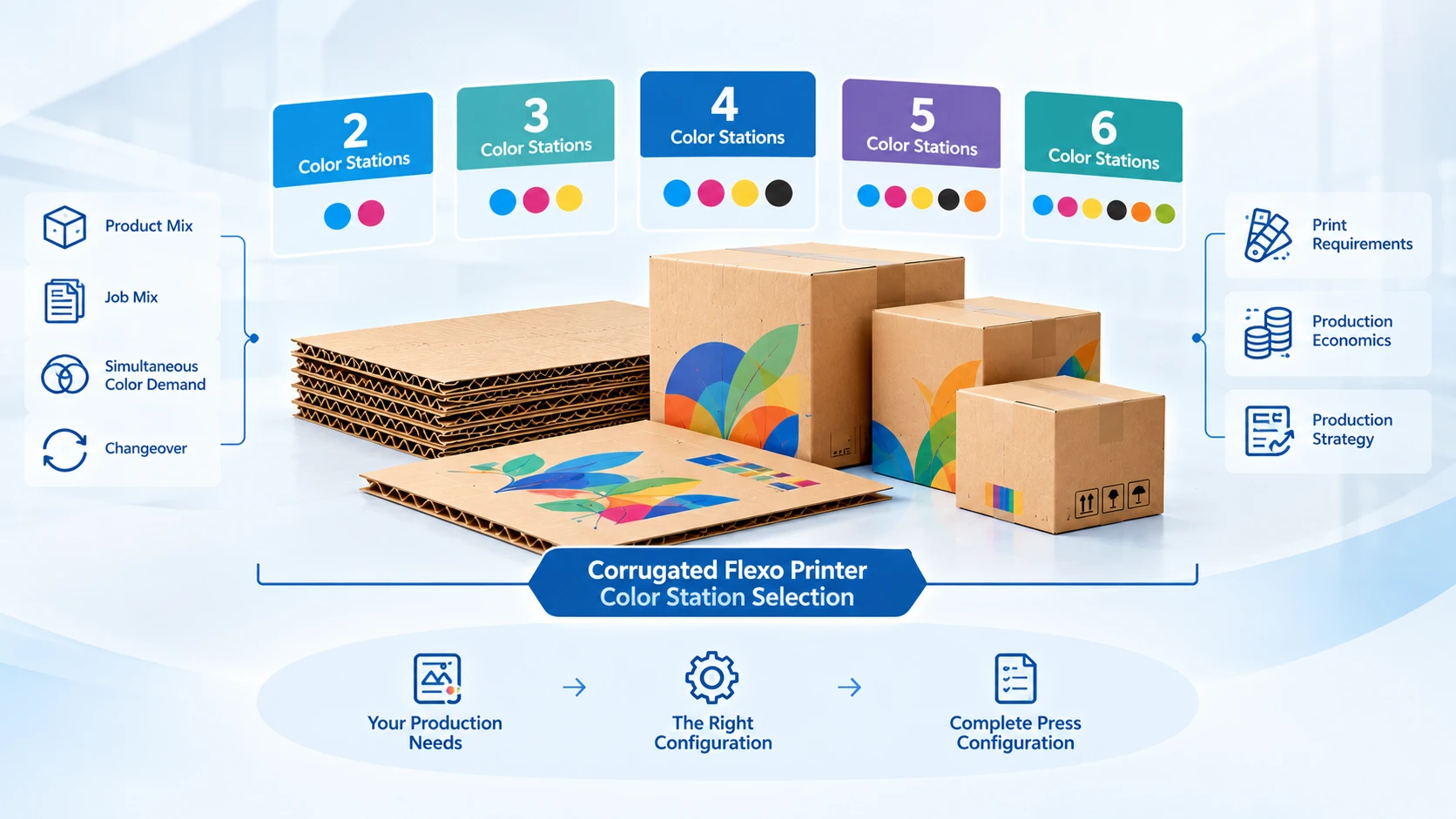
Start with how many colors your plant’s long-term, recurring core jobs need to print simultaneously. Then decide which configuration range — 2, 3, 4, 5, or 6 colors — actually fits your production system.
This article focuses only on 2–6 color configuration decisions. If you are still comparing flexo and digital printing as technology routes, you may first review [flexo vs digital printing for corrugated boxes]. Once the printing technology is settled, you can move on to the color-station count.
Choosing the right number of corrugated flexo printer color stations is not about buying the highest station count. It is about matching the press to the jobs you actually run.
Corrugated Flexo Printer Color Stations: What Does Color Station Count Actually Mean?
One Color Station / Printing Unit — What It Adds
In a corrugated flexographic press, a color station or printing unit is a basic unit that can independently print one color. Each unit typically includes an ink delivery and metering system, a plate cylinder, an impression cylinder, and other core components. Depending on machine design, the ink delivery system may use an ink fountain, doctor blade, chambered doctor blade, or another metering arrangement. Unit structures can differ between machines. Each additional station adds one independent physical printing position, which means one more color or process unit can be printed simultaneously.
For basic concepts around color stations, printing units, and flexographic color technology, FTA’s [Flexographic Color Fundamentals] provides useful industry background.
Color station count, however, is only one part of the machine configuration. It is not the whole measure of press capability. When purchasing, it is worth asking not only “How many color stations does this machine have?” but also “What problem does each of these stations solve for my long-term orders?”
More Color Stations Mean More Color Capacity — Not Automatically Better Print Quality
Adding color stations increases the ability to print more colors or process units simultaneously — that is, color capacity. It does not automatically upgrade print quality.
Print quality is also affected by registration systems, ink transfer, the anilox and plate system, board condition, color management, machine architecture, and operating conditions. Depending on how these factors are engineered, a well-built 3-color press can deliver better print quality than a 6-color press with weak structure or poor process control. Station count alone does not settle that comparison.
A more accurate way to understand this is:
More colors = more capacity, but only valuable when that capacity solves a recurring production need.
An extra station is only worth its cost when it solves a recurring production need. If it exists only for one special job that appears very rarely during the year, the added configuration may not create real production value.
For a deeper look at how system factors affect print quality under high-speed production, see [print quality at higher speeds] .
Process Colors, Spot Colors and Other Process Requirements
When deciding the number of color stations, do not directly equate the “visual number of colors” in a packaging design file with the number of stations the machine needs.
In actual production, it is necessary to distinguish:
- Process colors: usually formed through multi-color overprinting.
- Spot colors: when a job calls for multiple spot colors at the same time, each one generally needs its own printing unit. This does not mean every spot color permanently occupies a dedicated unit. Spot-color consistency also depends on ink formulation, measurement, and process control.
- Other process requirements: such as white ink, coating, or other special functional coatings.
A packaging design file may contain many visual colors, but how those colors are produced, how they are combined in printing, and what machine configuration they require must be judged against the actual production plan. What matters is not the number of colors in the design file, but which of them need to be printed at the same time.
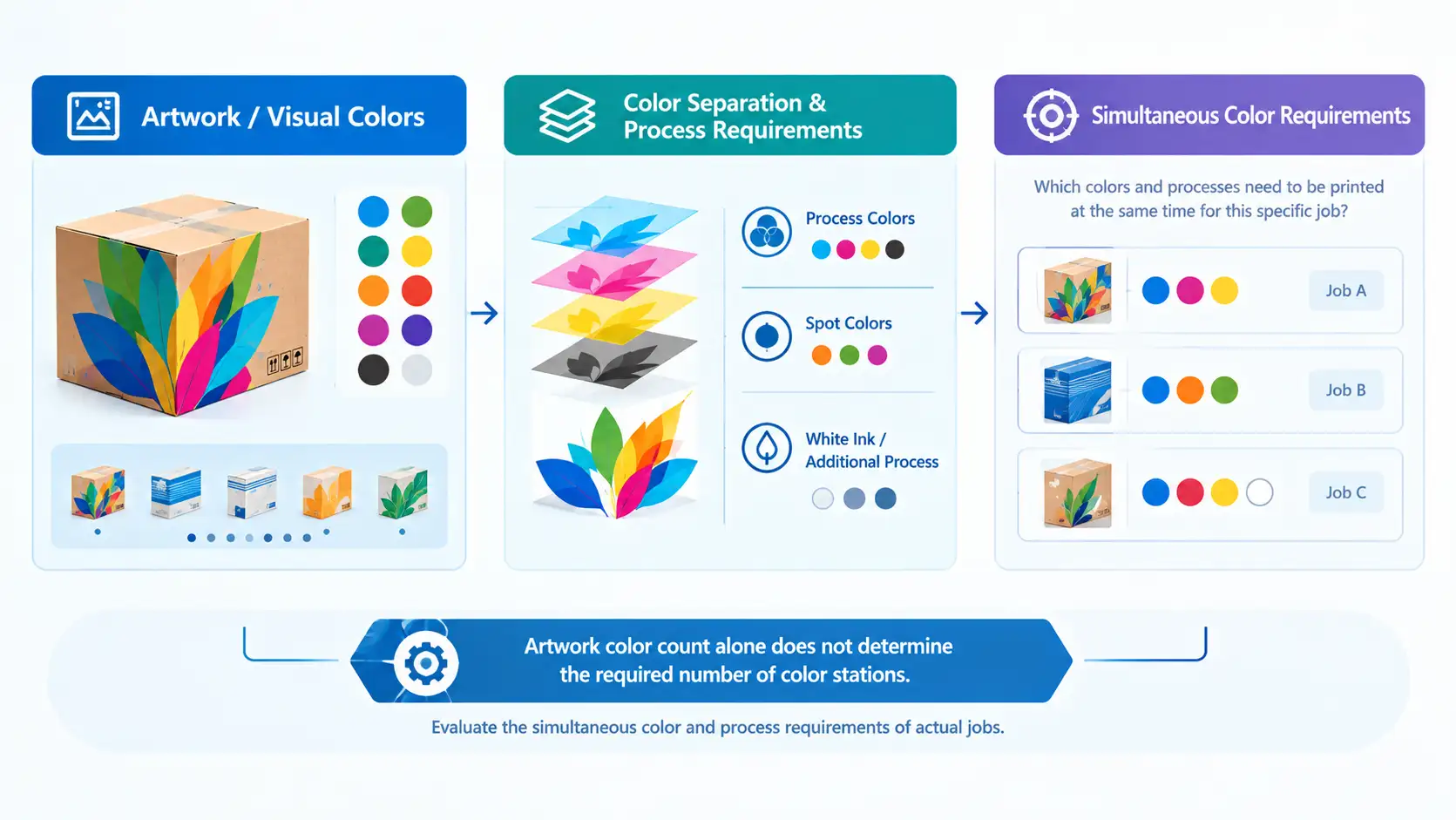
- Which colors must be printed simultaneously?
- Which colors are stable, recurring requirements?
- Which colors appear only on occasional orders?
Whether a station is assigned to white ink, coating, or another process is a machine-specific configuration issue. Different machines are designed differently. The actual machine configuration should govern, and no single station-assignment rule applies to every press.
Start With Your Real Order Mix, Not Your Maximum Color Count
How Many Colors Are Used Simultaneously?
The first statistical basis for color-station selection is not “how many colors appear in the design file.” It is “how many colors actually need to be printed simultaneously.”
A packaging design may contain multiple visual colors, but through overprinting, spot colors, or process combinations, the actual number of simultaneously used stations may be lower or higher. Consider a plant that prints large volumes of two-color or three-color boxes. Over the year it may use dozens of different spot colors. But as long as no single board requires more than three colors at the same time, the machine’s station count should not be decided simply by how many spot colors were used across the year. The method of switching spot colors depends on the specific machine’s ink supply system, cleaning design, and production organization. It should be confirmed against actual machine conditions.
Review your actual orders and note:
- Simultaneous color count for core products.
- Color combinations of high-frequency SKUs.
- Color combinations of repeat orders.
- Color usage of major orders from different customers.
How Often Do Higher-Color Jobs Actually Occur?
How often higher-color jobs appear is an important factor in deciding whether to add stations.
It is necessary to distinguish two situations:
Recurring Demand
If higher-color combinations:
- Appear frequently;
- Have already become part of the main product structure;
- Have a continuous impact on production organization;
then adding color stations may have reasonable value.
Exceptional Demand
If higher-color jobs:
- Appear only occasionally;
- Are not part of the main business direction;
- Do not point to where the product mix is heading;
then they should not automatically become the basis for long-term machine upgrading.
Equipment investment should serve long-term production strategy, not a single special requirement.
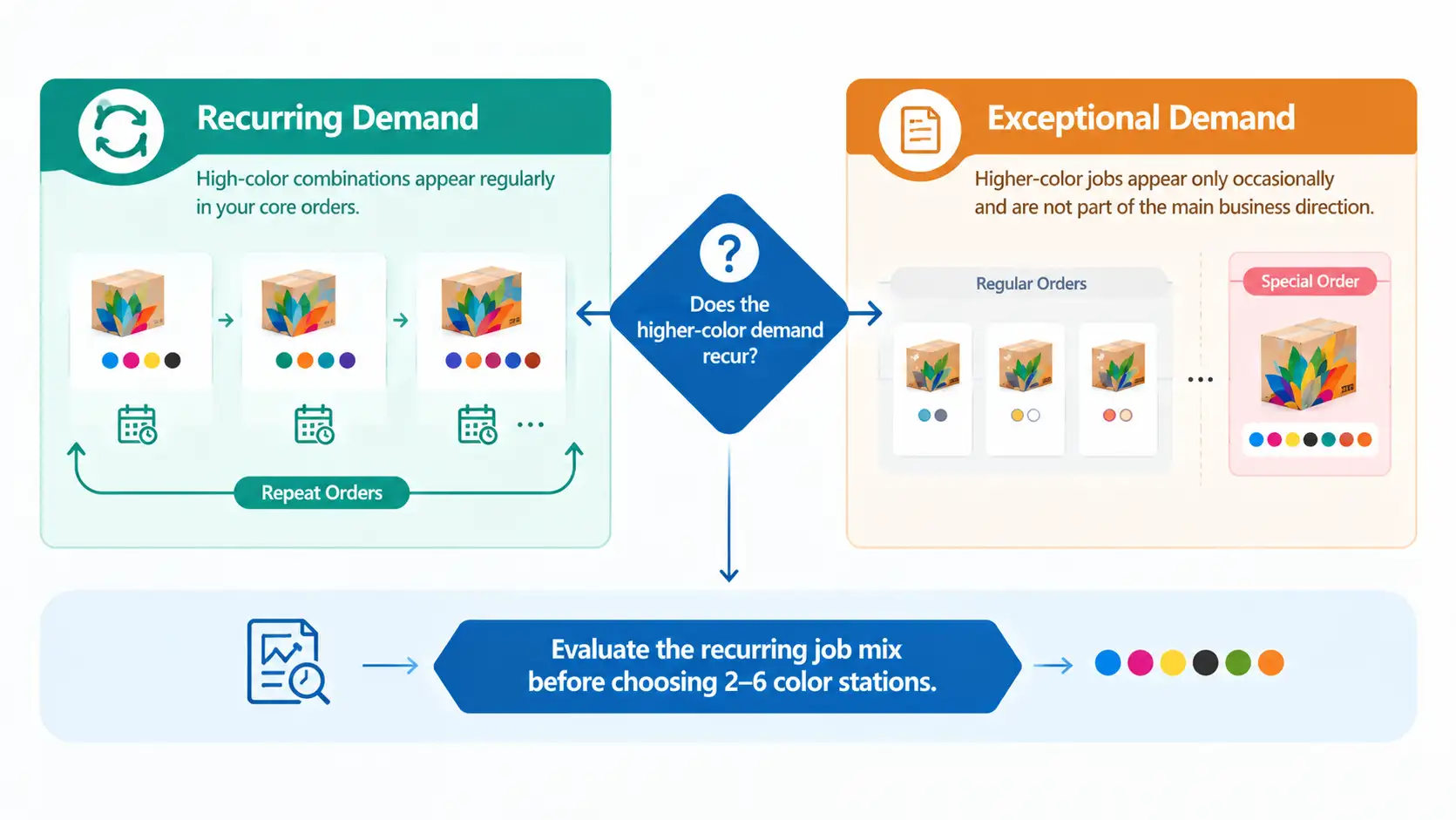
Do Not Size the Press Around One Exceptional Job
A common mistake is to choose the highest configuration because one order once required more colors.
When matching a press to a plant, a manufacturer usually needs to ask whether the order structure supports long-term use of that configuration. A special order may be worth studying, but it is not necessarily enough to determine the color-station count of an entire flexo press.
A more reasonable approach is to:
- Analyze core orders;
- Count actual simultaneous color requirements;
- Judge the frequency of higher-color demand;
- Evaluate whether the extra stations solve a long-term production problem.
The goal is not to buy the machine with the highest color count. It is to choose the configuration that best matches the business structure.
2–6 Color Configurations: A Direct Comparison
When determining color-station count, buyers often want a simple answer: “Among 2, 3, 4, 5, and 6 colors, which is best?”
From the perspective of machine design and production matching, there is no best color count in isolation from the business structure. Different color-station configurations solve different production needs. When comparing configurations, then, the focus is not on which level is higher. It is on which configuration can reliably cover your core orders while avoiding extra capacity that sits idle for long periods.
The comparison table below is intended to help buyers build a judgment framework. It does not mean that more color stations are more advanced, nor does it mean that a particular color count is universally optimal. 10-color is included only as background reference and is not presented alongside 2–6 color as an equal purchasing option.
| Configuration | When It May Fit | Main Procurement Question | Risk of Too Few | Risk of Too Many |
|---|---|---|---|---|
| 2 Color | Core orders are consistently covered by two simultaneous printing colors | Has the third color become a stable, recurring requirement? | Multi-color jobs may require process compromises | Added stations lack real business support |
| 3 Color | The third color has become a stable part of core orders | Is the third color enough to justify a dedicated unit? | Three-color job coverage may be insufficient | Is there stable demand for a fourth unit? |
| 4 Color | Four-color jobs have stable commercial demand | Are four-color jobs part of the recurring order structure? | Four-color jobs may be constrained | Is a higher configuration truly needed? |
| 5 Color | More complex color combinations have become regular business | What long-term problem does the fifth unit specifically solve? | Adaptability to higher-color jobs may be insufficient | Utilization may be insufficient |
| 6 Color | High-color demand has become a stable part of the product mix | Does the higher configuration have ongoing utilization value? | Complex multi-color business coverage may be insufficient | Investment and overall configuration complexity may exceed actual needs |
| 10 Color | Background only: outside the main scope of this guide | Is this a special, non-mainstream requirement? | — | Not a primary procurement option in this article |
The most important function of this table is not to tell you “how many colors to buy.” It is to help you see how much of a gap there is between what your press can do and what your recurring orders actually require. No configuration is inherently higher-grade than another. What matters is whether it matches the order structure.
When a 2-Color Press Makes Sense
The core criterion for a 2-color configuration is not “the orders are simple.” It is whether long-term core orders can mainly be covered by two simultaneous printing colors.
If most of the plant’s repeat production jobs have:
- Relatively stable color combinations;
- Infrequent demand above two colors;
- No clear sign that the product mix is moving toward more colors;
then a 2-color configuration may be able to meet the main production needs.
Choosing 2-color does not mean choosing a lower-grade machine. The real question is whether the third color has already become a stable, recurring production requirement worth configuring for the long term. If it has not, adding stations may only add machine capability without creating corresponding value.
When 3 Colors Become Reasonable
A 3-color configuration is usually based on this kind of business change: the third color has moved from occasional to regular demand.
For example:
- The third color is frequently required in core orders;
- The product mix begins to call for more colors;
- The two-color configuration begins to limit some repeat business.
What matters is not whether a three-color order appears occasionally, but whether the third color has become part of the normal order structure. If third-color demand comes only from a small number of special orders, the overall production frequency still needs to be considered.
When 4 Colors Become the Better Fit
A four-color configuration is often considered when jobs require fuller multi-color graphics. When the product mix shifts from simple text boxes toward e-commerce or retail packaging with color images, and such orders have become a steady, sizable part of the business, a 4-color press is a reasonable baseline.
Whether to choose four colors still depends on the actual business structure. It is necessary to evaluate:
- How often four-color orders appear;
- How the product mix is changing;
- Spot color requirements;
- Credible future business direction.
Four-color is not automatically the best choice for every plant. Whether a company needs four colors depends on whether four-color capability can solve long-term production needs.
When 5 Colors Are Justified
A 5-color configuration requires more careful judgment. Adding a fifth station raises a core question. It is not simply “can it print more colors?” The question is whether the fifth station solves a long-term product or process need.
If a company:
- Frequently faces more complex color combinations;
- Has high-color orders that have become stable business;
- Can reduce long-term production constraints with the fifth station;
then a 5-color configuration may have reasonable value. If the fifth color is mainly used for very rare special orders, however, the necessity of the investment should be re-evaluated.
When 6 Colors Are Worth Considering
A 6-color configuration makes sense when high-color orders are a stable and commercially important part of your business.
When considering 6-color, pay attention to:
- Whether multi-color orders continue to appear;
- Whether high-color products are a clear future direction;
- Whether the overall production system can match the configuration.
6-color provides greater color capacity. But color capacity itself is not the goal. The goal is to keep the machine configuration aligned with long-term production needs.
6-color does not automatically mean higher quality, a higher grade, or suitability for every plant. It is one configuration choice that fits certain business structures.
Why 10 Colors Are Only a Background Reference Here
This article focuses on 2–6 color configurations because this range better matches the color-station selection decision in most corrugated flexo equipment purchases.
A 10-color press is outside the main scope of this guide and is not presented as an equal procurement option. It represents a possible direction for higher color capacity, not the standard selection path recommended here. Buyers should not directly equate “higher color count” with “more reasonable machine configuration.”
Five Factors That Should Determine Your Color Station Count
Color station count is not an isolated machine parameter. It is the result of matching order structure, printing requirements, process requirements, production organization, and complete press configuration. Before deciding how many color stations a corrugated flexographic press needs, consider the following five factors.
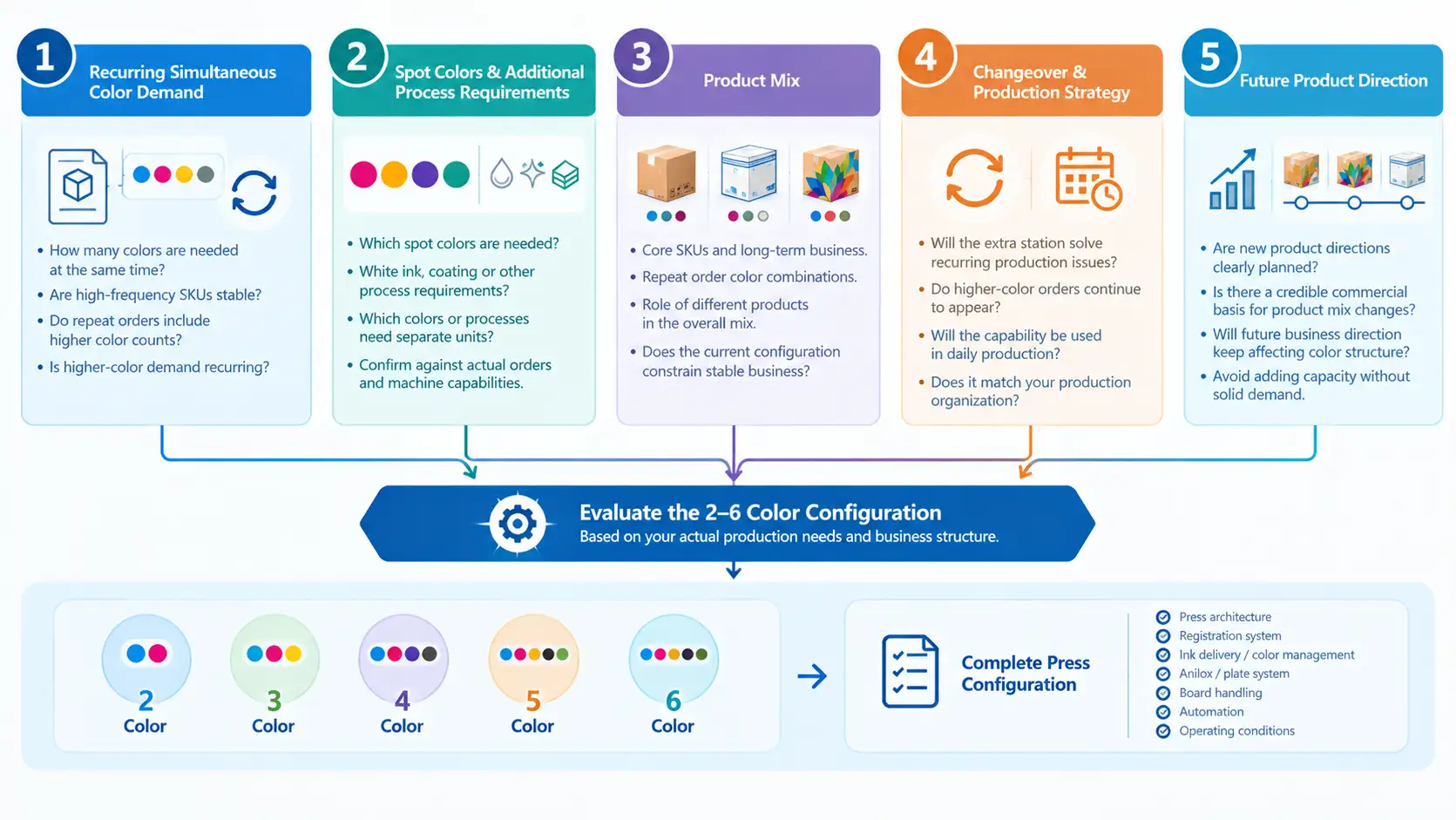
1. Recurring Simultaneous Color Demand
This is the first factor in color-station selection.
Buyers need to focus on:
- How many colors core products usually need to print simultaneously;
- Whether the color combinations of high-frequency SKUs are stable;
- Whether repeat orders frequently include higher color counts;
- Whether jobs requiring more colors than the current configuration appear on a continuous basis.
The most important word here is “recurring.” If higher-color demand appears only in a few special orders, it cannot be directly equated with long-term equipment demand. If a third, fourth, or additional color already appears consistently in core orders, then the corresponding stations may have clear production value.
Start with actual simultaneous color demand. Then decide the color station count.
2. Spot Color and Additional Process Requirements
In addition to the number of simultaneously printed colors, spot colors and other actual process requirements also need to be analyzed.
Key points include:
- Combinations of process colors;
- Requirements for spot colors;
- White ink, coating, or other specific process requirements;
- Which colors or processes require separate printing units.
Do not assume that because a design file contains many colors, the machine must be configured with the same number of color stations. Likewise, do not treat a particular station assignment method as a universal rule for all machines.
How many stations are actually needed, and what function a given unit performs, should still be confirmed against actual orders and machine configuration.
3. Product Mix
One order cannot represent the entire plant. A more reasonable approach is to look at core SKUs, product mix, and repeat order structure together.
A plant may have both regular orders with relatively simple color requirements and products with more complex color combinations. Buyers need to judge what role each type of business plays in the overall order structure, rather than making decisions only around the most complex order.
Questions to answer include:
- Which products form the long-term core business?
- Which color combinations repeat frequently?
- Is high-color demand changing the core product structure?
- Which stable business may be constrained by the current color-station configuration?
Machine configuration should serve the company’s real product mix, not just one exceptional order.
4. Changeover and Production Strategy
Does adding a color station truly solve a long-term issue in color changeover, process setup, or production planning? This question needs to be judged against actual conditions.
If an extra station can consistently handle the color requirements of core orders, then adding the configuration may have clear value. But a machine will not necessarily improve efficiency simply because it has more stations. Nor can it be claimed, without verification, that adding a certain station will cut changeover time by a fixed amount or raise capacity by a fixed percentage.
Purchasing evaluation should focus on:
- Whether higher-color orders continue to appear;
- Whether the extra station can solve recurring production constraints;
- Whether that capability will actually be used in daily production;
- Whether the color-station configuration matches the plant’s production organization.
The value of an extra station lies in the recurring problem it solves, not merely in how much potential capacity it adds.
5. Future Product Direction
Equipment purchasing needs to consider the future, but future demand must have a reasonable basis.
Factors worth weighing include:
- New product directions that have been clearly planned;
- Product mix changes with a credible commercial basis;
- Business adjustments likely to keep affecting the color structure of orders.
Do not keep increasing machine configuration simply because “more colors might be needed later.” What really needs to be judged is whether the future business direction is credible enough to generate ongoing production demand.
If the future direction is still unclear, evaluate the necessity of extra color stations carefully rather than defaulting to the highest configuration in one step.
A Practical Worksheet for Choosing 2–6 Color Stations
Before discussing configuration with an equipment manufacturer, you can organize the following information.
| Question | What to Check |
|---|---|
| What are your core products? | Main products, core SKUs, and long-term order structure |
| How many colors are normally printed at the same time? | Actual number of simultaneous colors |
| How important are spot colors? | Fixed brand colors, spot colors, and other process requirements |
| How often do higher-color jobs occur? | Frequency of jobs above the current configuration |
| Are those jobs recurring or exceptional? | Long-term recurring demand vs. occasional demand |
| Will your product mix change materially? | Credible future product structure changes |
| Does one more station solve a recurring problem? | Whether the added station truly solves a long-term production problem |
After organizing this information, buyers can discuss the right color-station range with much better information, rather than simply asking which configuration is more advanced.
The final judgment principle is:
If an additional station does not solve a recurring production need, “more capacity” alone is not enough reason to buy it.
Which Configuration Should You Choose?
The comparison and self-check table above give you a basis for deciding. In actual decision-making, the following principles can further help determine the configuration range suitable for evaluation.
Choose 2 Colors When…
- Core orders are mainly covered by two simultaneous printing colors;
- Demand above two colors has not become a stable, recurring part of the core business;
- There is no clear, credible short-term product expansion requirement.
Under these conditions, a 2-color configuration may already cover the main production tasks. What matters is not whether 2-color is a lower-grade choice, but whether it can reliably meet the company’s long-term core orders.
Choose 3 Colors When…
- The third color has become a stable part of core orders;
- Three-color demand is not occasional;
- Adding the third station can consistently ease actual production constraints.
If the third color appears only in a small number of special orders, further judgment is needed to determine whether that demand is enough to support a long-term increase in machine configuration.
Choose 4 Colors When…
- Four-color orders already have continuous commercial demand;
- The product mix truly requires a broader multi-color range;
- Four-color demand is part of the repeat order structure, not driven by a single special order.
A four-color press is reasonable only if four-color capability matches continuous demand in your actual business. It is not a universally applicable best answer.
Choose 5 Colors When…
- Higher-color combinations have become part of regular business;
- The fifth station can solve long-term color combination or process requirements;
- The added capability has reasonable ongoing utilization value.
If you cannot identify which products or production needs the fifth station will serve on a continuing basis, re-evaluate whether you need it.
Choose 6 Colors When…
- High-color orders have formed a stable, commercially meaningful business structure;
- The higher configuration has ongoing utilization value;
- The larger machine configuration matches the overall production conditions.
6-color gives buyers more flexibility in color configuration, but they still need to confirm whether this capability truly corresponds to long-term production demand.
Do Not Use One Exceptional Job to Justify the Maximum Configuration
A special order may deserve careful evaluation, but it does not automatically mean the entire machine should be configured around that order. Only when higher-color demand is credible, recurring, and commercially meaningful should it drive long-term machine configuration.
Once you have determined the color-station range, the next step is to match it with the complete press configuration, including registration, board handling, ink systems, automation, and the actual production workflow. The principle is simple: determine how many colors are needed first, then match the complete press. Do not start by pushing a machine and then find reasons to justify more colors.
Color Station Count Is Only One Part of Corrugated Flexo Printer Selection
Once the color-station range is clear, equipment selection still needs to consider other system factors, including:
- Press architecture;
- Registration system;
- Ink delivery / color management;
- Anilox / plate system;
- Board handling;
- Automation;
- Operating conditions;
- Order rhythm and product mix.
These factors need to be evaluated against the specific machine and its production requirements. Complete press capability cannot be inferred from color-station count alone.
Because Jeytop designs and manufactures corrugated flexographic presses across the 2–6 color range, the color-station range you identify can be matched to an actual press configuration.
For a complete corrugated flexo printer purchasing framework, continue with [how to choose a corrugated flexo printer]. For broader carton printing equipment selection, consider [carton printing machine guide] according to the actual relationship between the article and the target page. For high-definition flexo technology and print quality, consider [high-definition flexo printing] when the main text genuinely needs to extend into that topic.
For broader corrugated packaging production background, refer to FEFCO’s [The Production of Modern Corrugated Packaging — Production Process].This material is used for industry production process background, not as direct evidence for a specific color-count combination or machine structure.
This article answers “how many colors are needed.” Complete equipment selection guides answer “how should the entire machine be matched.”
Final Takeaway
When choosing the number of color stations for a corrugated flexo printer, the most important thing is not how many colors the machine can be configured with, nor which configuration looks more advanced.
What truly needs to be answered is:
- How many colors do my long-term core orders usually need to print simultaneously?
Then continue to confirm:
- How often does this demand occur?
- Is it recurring demand or exceptional demand?
- Can adding one more station solve a production problem that keeps recurring?
- Will a credible shift in your product mix change this demand?
- After determining the color-station range, does the complete press configuration match actual production conditions?
The entire purchasing judgment can be summarized as:
Recurring Job Mix → Simultaneous Colors → Frequency → Product Direction → 2–6 Color Configuration → Complete Press Configuration
The final principle is:
Choose the configuration that reliably covers your recurring core jobs, not the configuration with the highest number of stations.
Discuss Your Corrugated Flexo Printer Configuration
If you are determining whether your corrugated flexo printer needs 2, 3, 4, 5, or 6 color stations, start by organizing your core products, order mix, simultaneous color requirements, higher-color job frequency, and credible future product direction. Then discuss the color-station range and complete press configuration with Jeytop. The goal is not to request a price before the configuration is clear. It is to confirm the engineering fit between your production needs and the press specification.

Li Yong
General Manager, Jeytop Industrial Group
I share practical insights on corrugated packaging machinery, production requirements, and equipment selection.