Li Yong | General Manager, Jeytop Industrial Group
I share practical insights on corrugated packaging machinery and production.
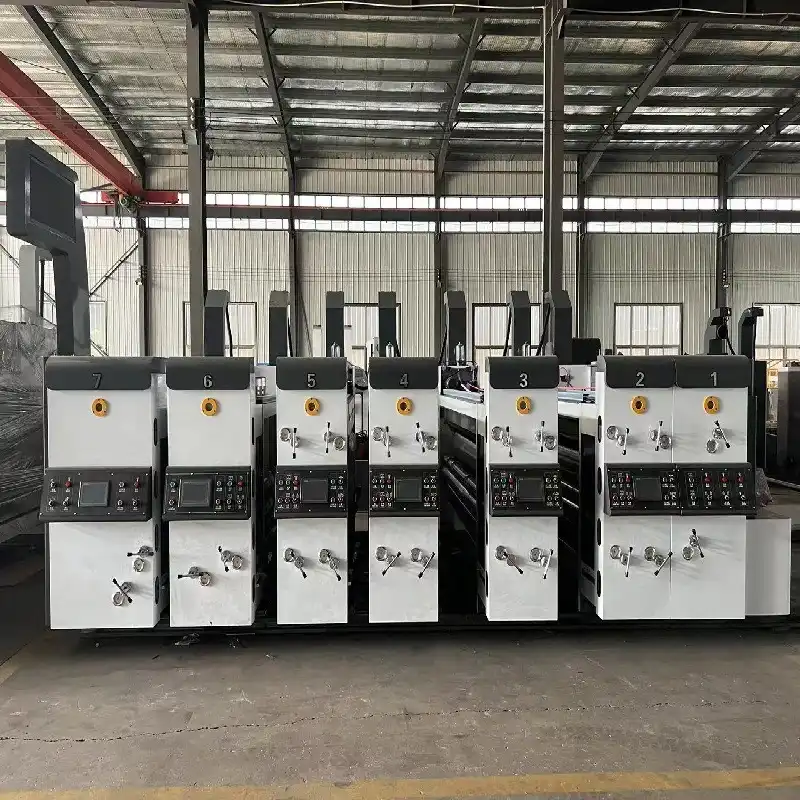
Choosing a corrugated flexo printer is not simply a matter of comparing maximum speed, the number of print units, automation features, or purchase price.
Two machines can look very similar on a specification sheet and still perform very differently in real corrugated box production. What matters is how the printing system, board handling, production speed, changeover efficiency, operating stability, maintenance requirements, automation, and future capacity work together under actual production conditions.
From the perspective of a machine manufacturer and system designer, equipment selection should therefore begin with a different question:
Does this machine really fit our products, production pattern, and operating conditions?
A practical evaluation sequence is:
Production Requirements → Printing System → Usable Production Speed → Changeover Efficiency → Stability and Control → Maintenance and Service → Future Fit → Supplier Evaluation
The purpose is to evaluate supplier specifications in the context of real production instead of comparing a few maximum values in isolation.
For a broader framework for evaluating carton printing equipment, you can also refer to [carton printing machine selection] to understand how equipment choices relate to production requirements.
1. Start With Your Production Requirements
Start by defining what the machine actually needs to do in your plant before comparing suppliers or configurations.
A machine that fits one corrugated box manufacturer may not be the right choice for another. Equipment comparisons become meaningful only after the product mix, board conditions, printing requirements, and order structure have been clearly defined.
Define Your Box Sizes, Board Types, and Product Mix
Start by identifying what you produce today and what you are reasonably certain you will produce in the future.
At a minimum, define:
- Common and maximum corrugated sheet sizes
- Common corrugated board types and flute profiles
- Board thickness and construction
- Common box styles
- Typical print layouts
- Typical number of print colors
- Order quantities and production frequency
- How often the product mix changes
These factors establish the basic boundaries for equipment selection.
For example, a plant producing relatively standardized orders in long runs may have very different priorities from a plant handling many short runs with frequent changes in board size, print requirements, and product format.
The comparison should therefore start with the plant’s product mix rather than with the supplier’s standard machine configuration.
Match Required Print Quality With Actual Production Needs
Not every product requires the same level of print control.
The purchasing team should first define what “print quality” means for its own products. This may include:
- Registration accuracy
- Solid ink coverage
- Print consistency
- Stability over long production runs
- Graphics complexity
- Repeatability from one order to another
The objective is not to pursue the highest possible print quality simply because it is available. The real issue is what level of printing control the plant’s products actually require.
If an advanced feature does not materially improve the production result for the intended product mix, it may increase equipment cost without adding equivalent production value.
For background on flexographic image reproduction, specifications, tolerances, and consistency, the FTA’s Flexographic Image Reproduction Specifications & Tolerances (FIRST) provides useful industry background. Its role here is to provide a framework for understanding quality control, not to turn that framework directly into acceptance values for a specific corrugated board product.
Separate Current Capacity From Future Expansion
Future requirements should be considered, but uncertain possibilities should not automatically become today’s purchasing requirements.
A useful way to structure the decision is to separate demand into three levels:
- Current production requirements that are already clear
- Future capacity expansion that is reasonably predictable
- Potential demand that cannot yet be confirmed
This avoids a common purchasing mistake: buying extensive capacity today for a future requirement that may not actually materialize.
True future fit should be based on a reasonably verifiable production plan, not simply on the desire to purchase the highest configuration available.
2. How to Evaluate a Corrugated Flexo Printer’s Printing System
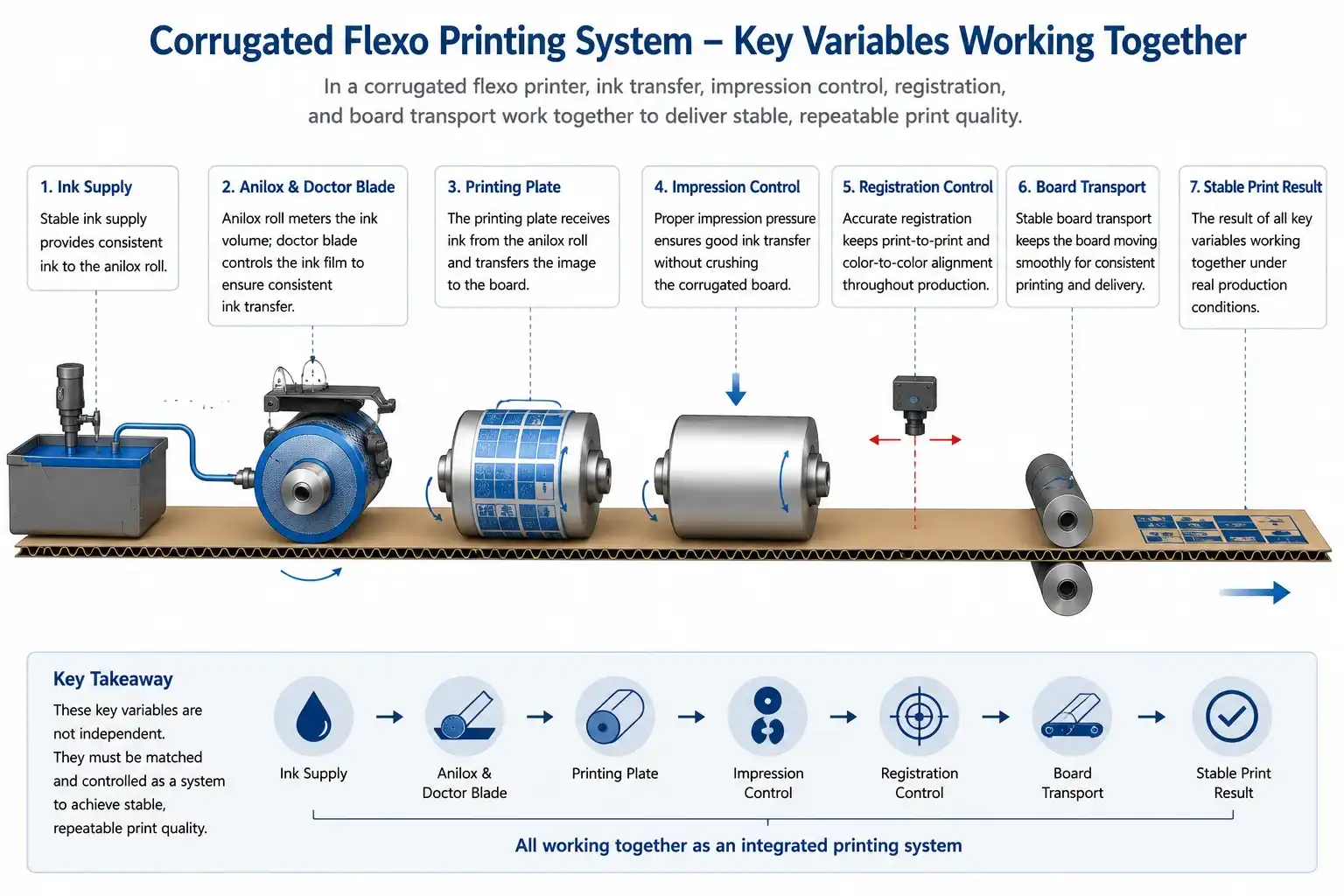
A corrugated flexo printer is an integrated printing system rather than a collection of unrelated components.
The printing units, anilox rolls, doctor blades, ink supply, impression control, registration, and board transport all interact. Looking at one parameter at a time can easily hide whether the overall printing system is properly matched.
Printing Unit Configuration and Color Requirements
The first step is to determine the printing configuration from the actual product mix.
Consider:
- How many colors are really required
- Typical print designs
- The combination of solids and process graphics
- The required level of color consistency
- Whether current order volumes can fully utilize additional print units
More print units do not automatically make a machine more suitable.
The real issue is whether the current product mix actually requires those capabilities.
The “maximum available configuration” should not be treated as the same thing as the “right configuration” for the plant.
Anilox, Doctor Blade, Ink Transfer, and Impression Control
Print quality is closely tied to the ink transfer process.
Anilox rolls, doctor blades, ink supply, printing plates, board condition, and impression settings influence one another. When evaluating a machine, it is therefore not enough to ask what brand or specification a component has.
A more useful way to evaluate the system is to ask how these variables are controlled and adjusted on the machine.
For example, the purchasing team can ask:
- How is ink transfer consistency maintained?
- How are anilox rolls matched to different print requirements?
- How is the doctor blade setting adjusted?
- How is impression pressure or the impression setting controlled?
- How does the machine help operators maintain repeatable process conditions?
These questions are more relevant to production than comparing one component specification in isolation.
For broader industry background on process control, standards, and quality consistency in flexographic printing, FTA’s Research and Standards resources provide useful reference material. Actual equipment evaluation should still return to the specific board, product, and machine operating conditions.
Registration Control and Print Repeatability
Registration is one of the key capabilities to evaluate when purchasing a corrugated flexo printer.
You can examine:
- How registration is controlled
- How adjustments are made
- Whether registration remains stable at higher production speeds
- Whether registration drifts during continuous production
- Whether repeatable print results can be achieved from one job to another
The key point is not simply whether the machine provides registration adjustment. It is whether the overall system can maintain the required registration under real production conditions.
That means considering speed changes, board conditions, and machine operating state rather than relying on one static registration accuracy figure.
Match the Printing System to the Intended Process
The objective of equipment selection is not to find the most technically complex machine. It is to find the machine whose printing system best matches the production task.
A practical question is:
What printing system does our product mix actually require to achieve stable production without adding unnecessary configuration, complexity, and cost?
This is one area where a machine manufacturer should contribute more than a configuration list. The manufacturer should be able to explain under which production conditions a given configuration creates real value.
3. Evaluate Usable Production Speed, Not Rated Speed
Speed is one of the easiest machine specifications to compare and one of the easiest to misunderstand.
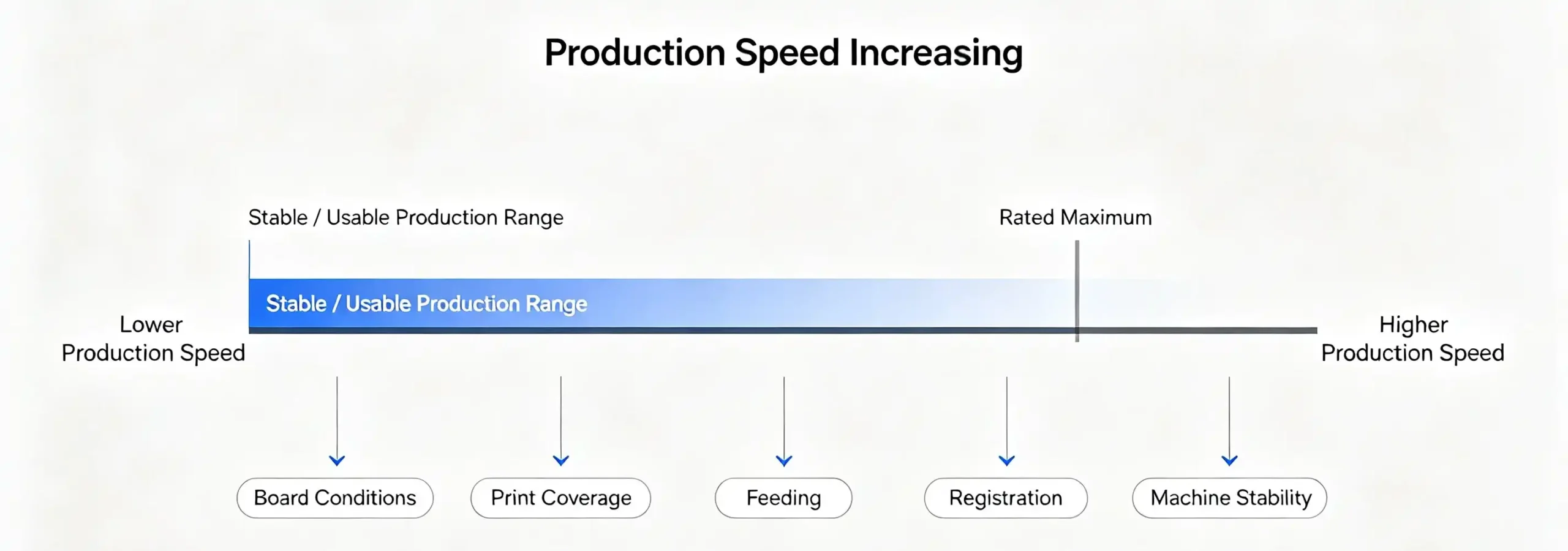
A supplier’s maximum rated speed does not necessarily represent the speed at which a plant can continuously produce acceptable corrugated boxes under normal operating conditions.
Rated Speed Versus Usable Production Speed
The maximum rated speed stated for a machine may be defined under particular conditions.
Actual production speed can also be influenced by:
- Board characteristics
- Board dimensions
- Print coverage
- Order complexity
- Feeding conditions
- Registration requirements
- Changeover frequency
- Operating method
- Overall machine stability
The more useful purchasing question is:
“At what speed can this machine run stably under our typical production conditions?”
That is not necessarily the same as asking for the machine’s maximum rated speed.
From a manufacturer’s engineering perspective, usable production speed is the more relevant production measure: the speed range at which the machine can continuously maintain the required product quality and production stability under the target operating conditions.
Registration Stability at Higher Speeds
As production speed increases, small changes in feeding, drive behavior, board movement, and other operating variables can become more visible in the printed result.
High-speed performance should therefore be evaluated together with print stability.
In a practical machine comparison, it is useful to look at [print quality at higher speeds] and examine whether registration remains stable as production speed changes.
It is also useful to consider registration stability at higher speeds to understand how controllable registration remains when the machine moves from lower speeds toward the intended production range.
This does not mean that one mechanical design should automatically be judged as “better.” A more useful evaluation is to ask the supplier to explain how the machine maintains stable board movement and print control at the target speed, board condition, and print requirement.
Print Quality During Continuous Production
A successful test print does not by itself demonstrate sustained production capability.
During equipment acceptance and supplier comparison, pay attention to what happens after the machine has been running continuously:
- Does print quality remain consistent?
- Does registration remain stable?
- Does board feeding remain consistent?
- How often is manual correction required?
- Does the control system remain effective during sustained production?
Changes in temperature, ink condition, component condition, and board condition can all influence the result over time.
The real value is therefore not simply producing one acceptable sample.
It is:
Can the machine repeatedly and continuously produce acceptable products?
4. Treat Changeover Efficiency as a Production Factor
For a corrugated box plant with frequent order changes, changeover efficiency is not a secondary feature. It is part of real production capacity.
A machine can have high theoretical output and still lose productive time when every job change requires extensive manual adjustment and verification.
Why Order Structure Changes the Value of Changeover Speed
The value of fast changeovers depends directly on the plant’s order profile, including the number of jobs processed each day, average run length, and the amount of variation in size and print requirements.
If the plant mainly runs large-volume, long-run orders, the effect of changeover time may be relatively limited.
But when order quantities are smaller and product changes are frequent, repeated setup time can consume a much larger share of available production time.
Changeover should therefore be evaluated together with the plant’s order structure rather than as an isolated “fastest changeover time” figure.
What Counts as Real Changeover Time?
One important purchasing issue is how the supplier defines “changeover time.”
A theoretical sequence of machine adjustments is not necessarily the same as the production changeover time that matters to the plant.
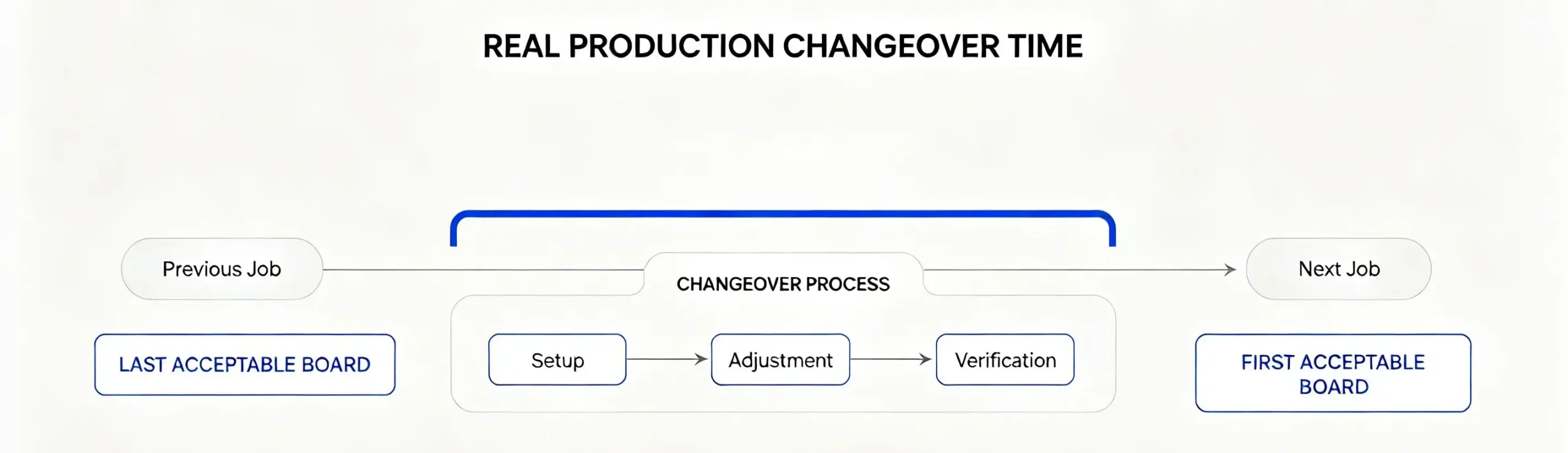
In actual production, the relevant interval is closer to:
Last acceptable board from the previous job → First acceptable board from the next job
That interval may include:
- Parameter adjustment
- Feed setup and verification
- Registration adjustment
- Impression adjustment
- Print verification
- Operator inspection
- First acceptable board confirmation
A quoted changeover time therefore needs to be evaluated together with the test conditions and measurement method used by the supplier.
Which Automation Features Actually Reduce Setup Time?
Automation does not automatically mean that every function has the same production value.
During evaluation, ask:
- Which manual adjustment actions are actually eliminated?
- Which parameters can be stored and recalled?
- Which settings still require operator confirmation?
- Which changeover steps still require machine stoppage?
- Which setup steps or activities are actually shortened by the automation?
The important question is not how many automation functions a machine has.
It is:
Does the automation actually reduce non-productive time in the production process?
From a machine design perspective, the value of automation should always be connected back to the actual workflow: which action is eliminated, at which changeover point the benefit occurs, and whether that benefit matches the plant’s order profile.
5. Evaluate Stability and Operating Control
A corrugated flexo printer is not successful simply because it can print a board during a machine test.
The equipment must maintain the relevant mechanical relationships and process conditions throughout continuous feeding, board transport, printing, and delivery.
Mechanical Stability and Drive Accuracy
A stable mechanical system is the foundation for repeatable printing.
During evaluation, consider:
- Overall machine structural stability
- Drive accuracy
- Consistency of mechanical adjustment
- Stability of rotating assemblies
- Repeatability under load
A single structural feature should not automatically be treated as proof that one machine design is better than another.
A more useful approach is to ask the supplier to explain under which production conditions a particular design feature creates value and how it influences operating results.
From a manufacturer’s perspective, the engineering relationship can be summarized as:
Machine Design → Controlled Variables → Operating Conditions → Production Results
The supplier should be able to explain that relationship clearly.
Feeding and Board Handling Consistency
The board itself is what the printing system has to move and print, so feeding and board handling must be evaluated together with the printing system.
Pay attention to:
- Feeding consistency
- Adjustment across different board sizes
- Consistency of board movement through the machine
- Machine response when board conditions change
- Feeding stability as production speed increases
The key issue is not the specification of one feeding component.
It is:
Can the feeding system provide consistent board movement for stable printing?
Pressure and Registration Control
Print results depend on the relationship between the board, printing plate, ink transfer, and impression pressure.
Equipment evaluation should therefore focus on how these parameters are set, adjusted, and maintained.
Avoid accepting a simple claim that a particular design automatically produces better quality.
A more useful purchasing framework is:
Engineering Design → Controlled Variables → Applicable Production Conditions → Expected Production Result
This approach makes it easier to judge whether a technical design feature has real production value.
Repeatability Between Operators and Jobs
An industrial machine should not depend entirely on one highly experienced operator to produce acceptable results.
Clear operating logic, consistent adjustment methods, and repeatable production settings can help reduce variation between operators.
For this reason, operator repeatability should also be considered part of machine stability.
For a broader view of how different printing issues relate to one another, [common carton printing problems] can provide additional context on the relationship between print defects and operating conditions.
6. Evaluate Maintenance and Serviceability
Speed and print quality often receive most of the attention during machine purchasing, but maintenance requirements and serviceability become much more apparent once the machine enters regular production.
They should therefore be evaluated before the order is placed.
Access to Critical Components
Consider:
- Which components require routine inspection
- Which components need regular cleaning or adjustment
- How easy those components are to access
- How much downtime routine maintenance requires
- Which areas are likely to accumulate ink, paper dust, or production residue
- Which tasks can be handled by operators and which require maintenance personnel
A supplier should not stop at providing a spare-parts list.
The more useful question is:
How should routine maintenance actually be performed under normal production conditions?
Troubleshooting and Diagnostic Capabilities
When production problems occur, part of a machine’s value lies in how quickly and systematically operators can isolate the cause.
A printing problem in corrugated flexographic production may involve feeding, transmission, registration, impression, ink transfer, or board conditions.
A well-designed system should help operators progressively narrow the problem rather than treating every abnormal result as something that simply requires adjustment or maintenance.
This is why purchasing evaluation should consider the machine’s diagnostic and control logic, not only its hardware configuration.
Spare Parts and Engineering Support
Before placing an order, clarify:
- Which routine spare parts should be prepared
- Which components are considered critical
- How spare parts are identified and ordered
- What installation and commissioning support is included
- What engineering support is available after production begins
- How technical problems are communicated and handled
“Comprehensive technical support” is too broad to be useful on its own.
It should be broken down into concrete areas:
What is included in installation support, commissioning support, training, troubleshooting support, and ongoing engineering service?
For a manufacturer, these services are part of the machine’s life cycle, from installation and commissioning through long-term operation.
What Should Be Verified Before Ordering?
One practical method is to convert supplier marketing language into questions that can actually be verified.
Instead of asking:
“Is the machine easy to maintain?”
ask:
“Which routine maintenance tasks can our own operators perform, and how much downtime is required?”
Instead of asking:
“Is the machine highly automated?”
ask:
“Which setup actions are automated, and which still require operator intervention?”
Instead of asking:
“Is the machine high-speed?”
ask:
“Under what board, size, print, and production conditions was the quoted speed achieved?”
The closer purchasing questions are to verifiable production conditions, the more reliable the final decision is likely to be.
7. Check Future Fit Without Over-Investing
A corrugated flexo printer is typically a long-term production asset, so future requirements should certainly be considered.
But “future-ready” does not mean purchasing every possible configuration today.
Current Production Needs Versus Future Capacity
Future requirements can be assessed based on:
- Expected order growth
- Changes in product mix
- Changes in board dimensions
- Changes in printing requirements
- Changes in order frequency
- Capacity expansion plans
Then separate what is reasonably certain from what is merely possible.
This helps avoid paying for equipment capacity that may not be needed.
Which Upgrade Options Are Actually Worth Planning?
Future upgrades should be connected to real production needs.
For each upgrade under consideration, ask:
- What problem is it intended to solve?
- When is the plant likely to need it?
- Does the current machine architecture support it?
- What would the later upgrade require in cost and implementation?
- If it is not included today, will that affect any confirmed production plan?
This turns future planning into actual production planning rather than simply selecting the highest configuration.
It is also important to distinguish between capabilities that need to be defined during the initial machine design and options that can reasonably be added later.
Whether a specific upgrade can be added later depends on the machine architecture, installation conditions, and the manufacturer’s engineering proposal. It should not be assumed simply because a supplier uses the words “upgradeable” or “future-ready.”
Avoid Paying Today for Uncertain Future Requirements
A common purchasing assumption is:
“To make sure we do not outgrow the machine, we should buy the highest configuration today.”
That is not always the best approach.
A more practical principle is:
Future-ready ≠ Maximum Configuration
A well-planned machine should provide an appropriate base configuration while preserving practical upgrade paths for clearly defined future needs.
8. Compare Suppliers by Production Fit, Not Price Alone
Once the plant has completed its equipment requirements analysis, it can move into supplier comparison.
Price matters, but it should not be the only decision variable.
Build a Requirement-Based Comparison Checklist
The purchasing team should create one comparison framework based on its own production requirements rather than evaluating each supplier through a different set of specifications.
At a minimum, compare:
- Overall machine configuration
- Supported board sizes and product mix
- Printing configuration
- Registration control
- Usable production speed
- Changeover method
- Automation functions
- Maintenance accessibility
- Spare-parts support
- Installation, commissioning, and engineering support
- Future upgrade capability
- Overall fit with the plant’s production system
This avoids a common purchasing mistake: assuming that the supplier with more numbers on the specification sheet automatically offers the better machine.
Compare Complete Machine Configuration
A machine quotation should be evaluated as a complete configuration rather than as a list of separate options.
For example, the value of a high-speed configuration depends on whether the plant’s actual production conditions allow it to be used consistently.
Likewise, the value of automation depends on whether it actually reduces the setup actions that consume the most time in the plant.
The comparison should therefore cover the complete configuration, including core machine functions, relevant supporting equipment, and service scope rather than only the total purchase price.
Compare Production Fit, Serviceability, and Long-Term Operating Impact
The initial machine price is the most visible upfront cost. The consequences of a poor equipment match often appear later during production.
The evaluation should also consider:
- Equipment capabilities that may remain underused
- Excessive changeover time
- Overdependence on a small number of highly skilled operators
- Downtime risks caused by difficult maintenance
- Inconsistent printing performance
- Availability of technical support
- Limitations on future capacity expansion
A machine with a lower initial price does not necessarily create lower long-term equipment cost.
For broader reference on evaluating machine quality and equipment selection, [evaluating high-quality corrugated machines] can provide another perspective on configuration, production fit, and long-term use.
Questions to Ask the Manufacturer Before Ordering
Before placing the order, ask the manufacturer to address the following questions against your actual production conditions:
- Which machine configuration fits our product mix?
- What production conditions are required for the quoted performance?
- How are registration, feeding, impression, and other critical variables controlled?
- What commissioning and engineering support is included?
- Which settings are automated, and which still require operator intervention?
- What maintenance work is expected under normal production conditions?
- Which future upgrades are realistically compatible with the proposed machine configuration?
The value of these questions is not simply that they make the purchasing discussion more technical.
They move the equipment comparison from abstract specifications to actual production conditions.
Choose the Machine Around Your Production System
Choosing a corrugated flexo printer is fundamentally a production-system matching decision, not simply a machine price comparison.
The eight factors can be summarized as:
- Production requirements
- Printing system
- Usable production speed
- Changeover efficiency
- Stability and operating control
- Maintenance and serviceability
- Future fit
- Supplier and total production fit
The right machine for a plant is not necessarily the one with the highest rated speed, the most automation, or the highest purchase price.
What matters is whether the machine’s structure, printing system, board handling, control capability, production pattern, maintenance requirements, and engineering support match the plant’s actual operating conditions.
This is also where a manufacturer’s engineering capability becomes relevant to the purchasing decision. The supplier should be able to connect the plant’s product mix, board conditions, order profile, production speed, changeover needs, service requirements, and future capacity plans to a workable machine configuration.
Equipment selection should therefore not stop at answering, “What configuration can we supply?”
It should help the customer determine:
What configuration actually fits your products, capacity, operating conditions, and future development?
Once a plant has completed its internal requirements assessment and basic supplier comparison, the next step is to move into specific machine and production-line matching. The objective is to determine a practical equipment configuration based on actual operating conditions rather than continuing to compare generic specifications.
For a purchasing-stage customer, the most useful next step is not to pursue the highest configuration immediately. Start by organizing the product mix, board conditions, order profile, and expected capacity. These are the inputs needed for a meaningful configuration discussion.
From there, the plant can work with the Jeytop engineering team to evaluate machine configuration and production-line fit against those actual requirements. That discussion is intended to turn production conditions into a concrete equipment decision, rather than leaving the decision at the level of a specification sheet and quotation.

Li Yong
General Manager, Jeytop Industrial Group
I share practical insights on corrugated packaging machinery, production requirements, and equipment selection.