Li Yong | General Manager, Jeytop Industrial Group
I share practical insights on corrugated packaging machinery and production.
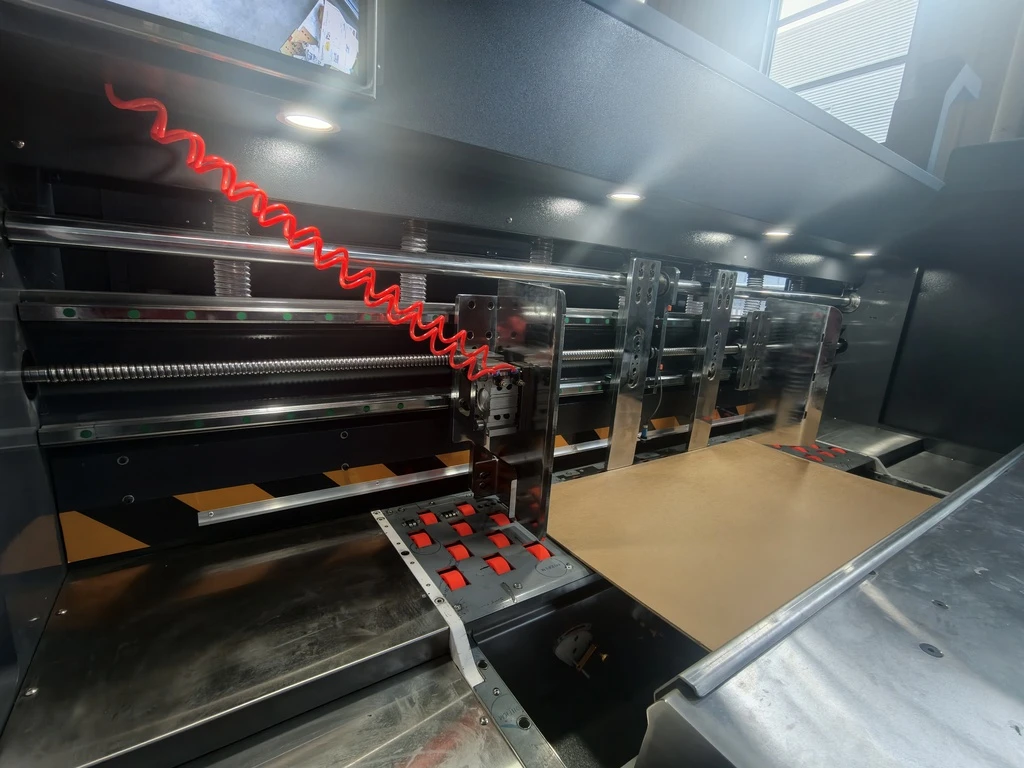
When corrugated flexo printer feeding becomes unstable during production, the symptoms are often easy to see: board skewing, slipping, double or multiple-sheet feeding, gradual position drift, or feeding errors that appear only after production speed is increased.
These problems may eventually show up as registration errors, changes in print position, or reduced consistency across a production run.
A common mistake, however, is to focus immediately on the printing units or keep changing a single machine parameter.
Stable feeding does not come from one parameter alone. Board condition, the feeding mechanism, alignment, pressure, transport timing and synchronization, and production speed all affect how the board actually moves through the machine.
A more reliable approach is to diagnose feeding and board transport along the actual path the board follows:
Board Condition → Feeding → Alignment → Pressure → Transport Timing and Synchronization → Print Position → Production Speed → Verification
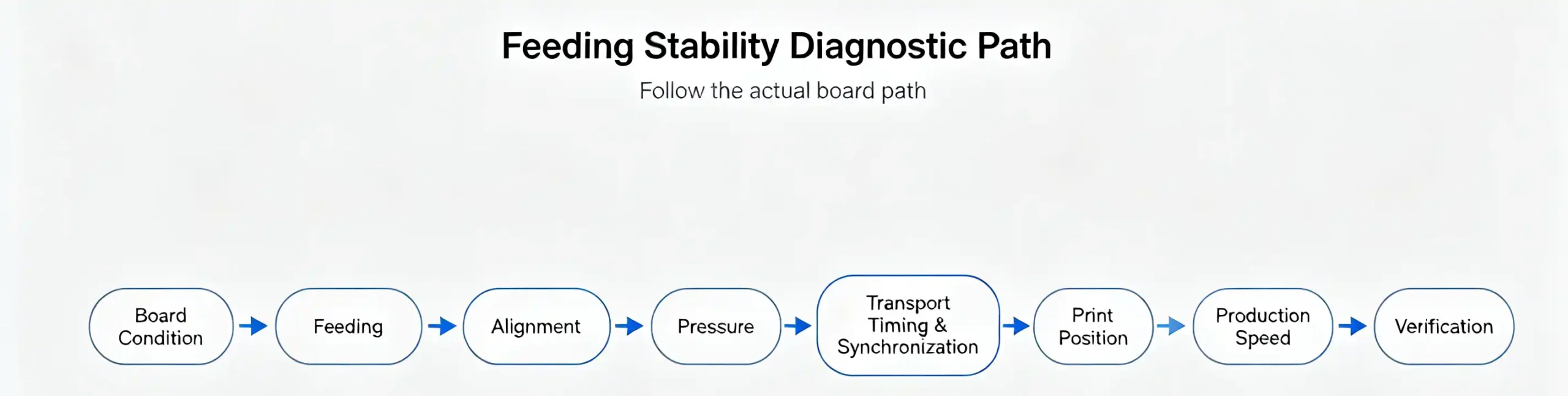
This article explains how to build that diagnostic path and how to recognize when a problem is still within normal adjustment range—and when it is time to stop compensating with parameters and inspect the mechanical condition or equipment capability instead.
Why Corrugated Flexo Printer Feeding Stability Matters
The feeding system establishes more than the initial movement of the board into the machine.
Before the board reaches the printing section, it needs to establish a stable position, direction, and movement pattern. If any of these conditions changes unpredictably, the printing process has to deal with a continuously changing input.
What Unstable Board Transport Looks Like During Production
Feeding instability can appear in several different ways.
Common symptoms include:
- Board gradually drifting or skewing after entering the machine
- Board travel becoming misaligned with the intended direction
- Slipping or intermittent loss of effective transport
- Two or more sheets entering together
- Inconsistent leading-edge position
- Gradual board-position drift during continuous production
- Stable feeding at lower speed followed by increasingly obvious problems as speed rises
These symptoms may look different, but they have something in common:
The board is not entering the downstream printing process in a sufficiently consistent and repeatable position and motion.
That is why feeding diagnosis should begin with what the board is actually doing, rather than assuming from the start which parameter is wrong.
How Feeding Instability Affects Registration and Print Position
The basic relationship is simple:
Feeding → Board Position → Print Position
If each board enters the printing units from a slightly different position, the final print position can shift even when the printing-unit settings have not changed.
For example, if the board has already moved slightly sideways before entering the print section, the downstream print position may shift with it.
This is why some problems that appear to be registration issues cannot be diagnosed by looking only at the printing units.
If your plant is dealing with registration changes after increasing production speed, you can also refer to registration problems after a speed increase for additional context on the relationship between feeding, speed, and registration.
Why Feeding Problems Should Be Evaluated as a System
Feeding stability is not the result of one isolated mechanism.
Between entry into the machine and arrival at the printing section, the board passes through several connected stages. A change at one stage can show up as a symptom further downstream.
From a machine manufacturer’s engineering perspective, a reliable evaluation asks:
Is the board condition stable? Is feeding stable? Is alignment stable? Is the pressure appropriate? Is transport synchronized with the downstream process? Is the current speed still within the stable operating range?
Considering these factors within one diagnostic path helps prevent one parameter from being repeatedly adjusted to compensate for a problem elsewhere.
Check the Board and Feeding Conditions Before Making Adjustments
Many feeding problems do not begin with a machine parameter suddenly becoming incorrect. The input conditions may have changed first.
Before adjusting the equipment, check the board condition and the current production environment.
Board Flatness, Warp, Moisture, and Surface Condition
Corrugated board is not a perfectly rigid, homogeneous material.
Warp, changes in flatness, moisture condition, and surface condition can all affect the actual contact between the board and the feeding mechanism.
When a feeding problem appears, first ask:
- Does the current board have noticeable warp?
- Is board flatness consistent between batches?
- Is there local deformation?
- Is the current board condition different from the condition during previous stable production?
- Has the board become more prone to slipping, drifting, or separating incorrectly?
For technical background on corrugated board warp, refer to TAPPI’s Cross direction warp in corrugated board, Technical Information Paper TIP 0304-07 (2022) as an external technical reference.
The point is not to conclude that the board condition itself is necessarily the root cause. First establish whether:
The board has changed the input conditions that the feeding system has to handle.
Board Dimensions and Feeding-System Compatibility
Changes in corrugated sheet dimensions directly change the working conditions of the feeding and alignment process.
Check:
- Whether the current sheet dimensions are within the machine’s normal operating range
- Whether feeding conditions need to be adjusted when sheet specifications change
- Whether the current guiding and alignment method is appropriate for the sheet size
- Whether small and large sheets behave consistently
- Whether the problem appeared immediately after a format change
If the problem occurs only with a particular size or board type, investigate whether the production conditions are driving the problem before assuming that the machine itself is unstable.
Production Speed and Current Feeding Conditions
Feeding performance can change at different production speeds.
At lower speed, a small transport variation may not be obvious. As speed increases, the same variation can become more visible as position drift, slipping, or feeding-timing irregularities.
When the problem occurs, record:
- Current speed
- Stable production speed
- Approximate speed range where the problem starts
- Whether the problem becomes worse as speed continues to increase
The key is not simply to reduce speed and push the problem back into an apparently stable range. First determine:
Is speed exposing a feeding weakness that was already present?
Distinguish Board-Side Variation From Machine-Side Instability
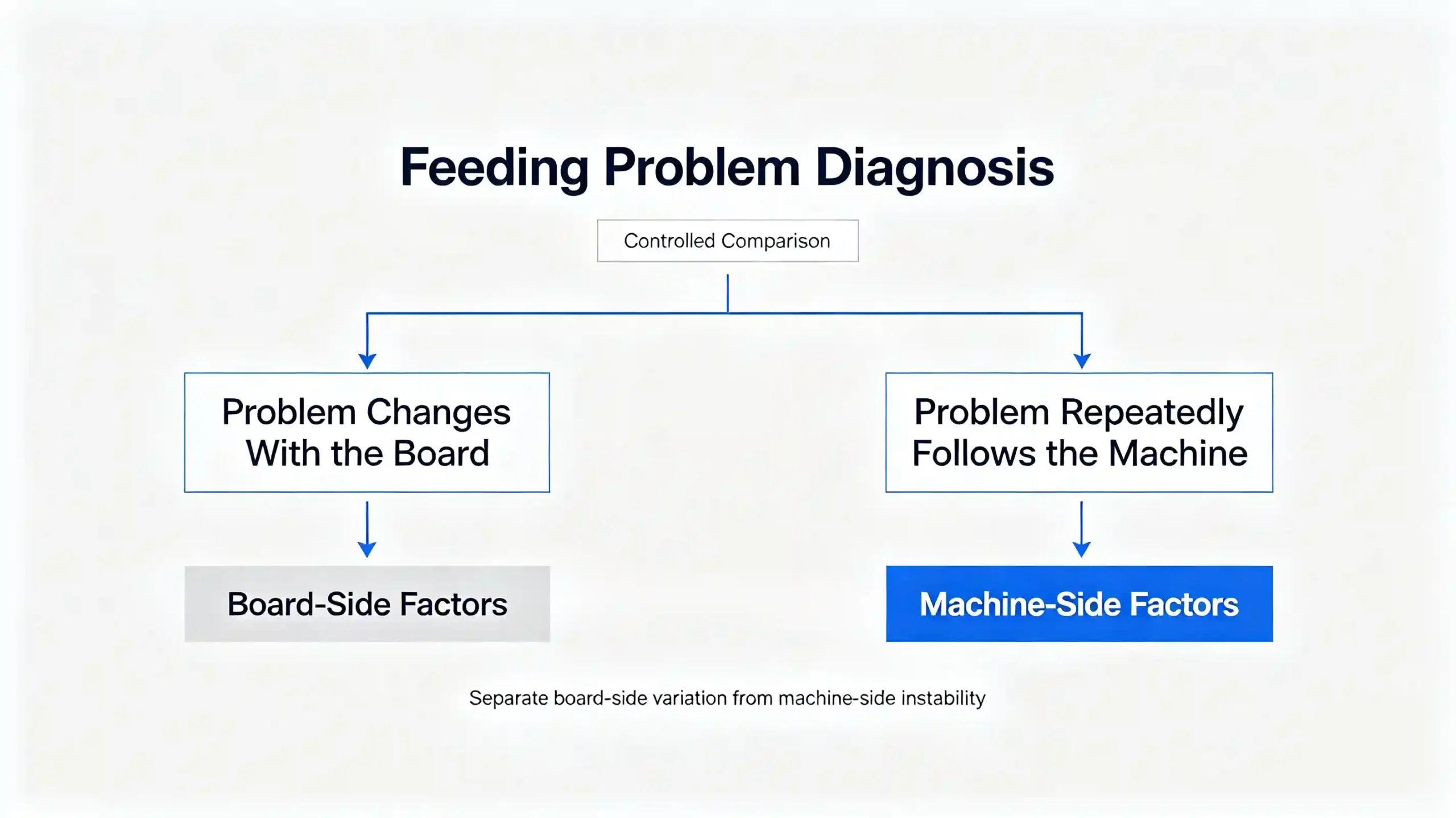
This is an important part of feeding diagnosis.
Controlled comparisons can help narrow down whether the source is board-side or machine-side.
If the problem becomes noticeably better when a more stable batch of board is used, board condition deserves closer attention.
If different board batches show similar feeding abnormalities and the problem repeatedly appears at the same machine location or under similar operating conditions, machine-side factors should move higher on the diagnostic priority list.
In other words, do not define the problem as a “machine parameter issue” too early.
First ask:
Does the problem follow the board, or does it follow the machine?
Key Feeding System Adjustments for Stable Board Transport
Once board and production conditions have been checked, move into specific feeding-system adjustments.
There is no universal parameter table that applies to every machine, every board type, and every production speed.
A reliable method is to ask three questions for every adjustment:
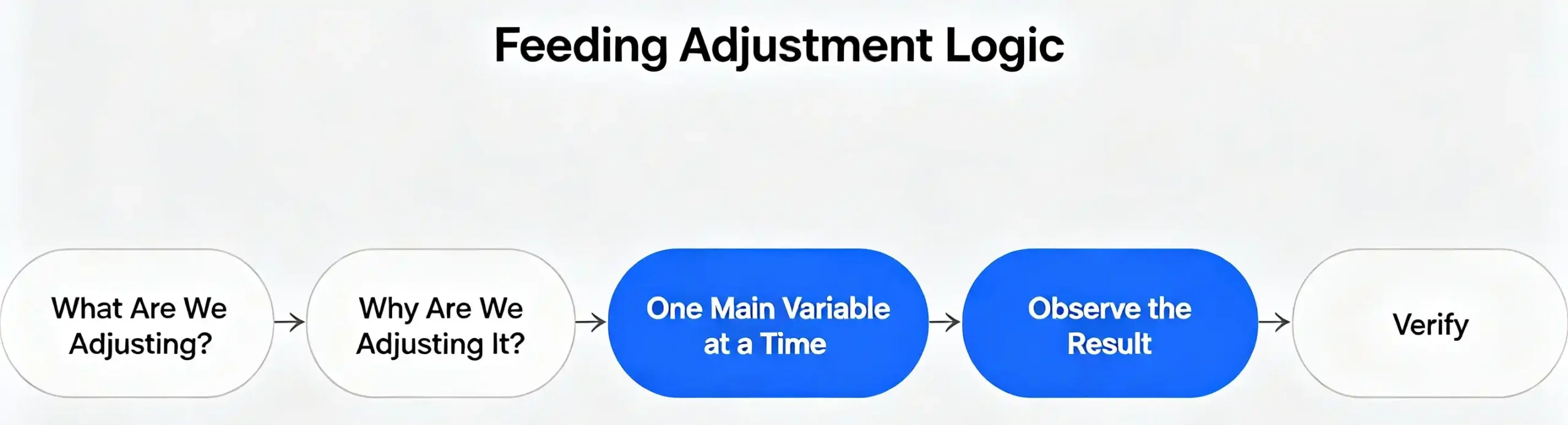
What are we adjusting → Why are we adjusting it → What should we observe afterward?
Feeding Gap and Board Separation
The feeding system must first separate individual boards and feed them consistently into the transport path.
If the feeding/separation gap is not properly matched to the current board condition, you may see:
- Feeding difficulty
- Board slipping
- Multiple sheets entering together
- Inconsistent leading-edge position
- Changes in feeding timing
Do not focus only on “what is the correct gap?”
The setting needs to be considered in relation to the board condition.
Even on the same machine, the appropriate operating range may change with the board condition.
After adjustment, observe whether the boards separate consistently, whether the leading edge remains stable, and whether new problems appear during continuous operation.
Side Guides and Board Alignment
The board needs a stable reference position as it enters the machine.
If the side guides are not maintaining the intended board alignment, operators may repeatedly compensate with other settings, yet the board can still shift before it reaches the printing section.
When checking the side guides, pay attention to:
- Whether the board maintains a stable direction at entry
- Whether the guides are actually providing the intended alignment
- Whether a new reference position is needed when board formats change
- Whether lateral drift is reduced after guide adjustment
If increasing pressure elsewhere is required just to keep the board in position, be cautious:
Are we using excessive compensation in one part of the system to hide a problem in the alignment stage?
Feed Rollers and Contact Pressure
Feed rollers need to establish stable and repeatable contact with the board.
Too little pressure may prevent reliable transport, but more pressure is not automatically better.
Excessive pressure can change the board condition, increase unnecessary mechanical loading, or force a problem that should be handled by alignment and transport control to be maintained through pressure alone.
When adjusting feed rollers, focus on:
Have we achieved stable transport, rather than simply using more pressure to create a stronger grip?
After the adjustment, observe whether the board moves consistently into the next stage and whether the problem has actually been reduced rather than temporarily suppressed.
Vacuum or Airflow Settings Where Applicable
For feeding systems that use vacuum or airflow assistance, airflow conditions should be evaluated as part of the overall feeding system.
The objective is not to achieve one fixed suction or airflow level. The important question is whether the assistance setting matches the board condition and transport method.
Consider:
- Whether the current board actually requires this assistance
- Whether the airflow is sufficient to maintain the intended feeding and transport condition
- Whether the assistance is excessive or insufficient
- Whether the current setting remains suitable when board specifications change
Because machine designs and feeding methods vary, no universal numerical setting should be given without reference to the specific equipment configuration.
Feeding Timing and Coordination With the Printing Units
Stable feeding is not only about getting the board into the machine. It is also about when the board reaches the next stage.
If feeding actions are not properly coordinated with the downstream printing units, the board’s arrival position may vary even when an individual mechanism appears to be functioning normally.
Observe:
- Whether board entry follows consistent timing
- Whether leading-edge position is repeatable
- Whether repeatability declines as speed increases
- Whether changes in feeding behavior appear together with changes in downstream print position
Feeding and printing should therefore be treated as one continuous production process rather than two completely separate systems.
How to Diagnose Feeding Instability Step by Step
This is the most important part of the troubleshooting process.
One of the easiest ways to make the cause difficult to identify is to change several feeding parameters at once and keep whichever combination happens to restore production.
That may make the problem disappear temporarily, but it does not tell you what the underlying cause was.
A more reliable method is to start with the symptom and progressively narrow the source.
Start With the Symptom: Skewing, Slipping, Double Feeding, or Position Drift
First record the actual symptom rather than describing it simply as “feeding is unstable.”
For example:
If the main symptom is skewing, focus on alignment and the board’s entry direction.
If it is slipping, check contact conditions, pressure, board surface condition, and transport conditions.
If it is double feeding, focus first on board separation and the relevant feeding conditions.
If the main symptom is gradual position drift, pay closer attention to transport consistency, feeding timing, and mechanical condition during continuous production.
The purpose of this step is to narrow down where the problem begins.
Check Whether the Problem Is Continuous or Condition-Specific
Next ask:
Does the problem occur all the time?
Or does it appear only with:
- A particular board type
- A particular size
- A particular speed range
- A particular order type
- A period of continuous production
For example, if the machine remains stable at lower speed but develops the problem as speed increases, speed has become an important diagnostic condition.
If only one board type is affected, the material-to-machine relationship deserves priority.
Compare Low-Speed and Higher-Speed Behavior
Production speed is particularly useful when comparing otherwise similar operating conditions.
Keep other conditions as consistent as possible and compare:
Stable at lower speed → Speed increases → Problem appears
Then determine when the problem begins.
Do not record only “unstable at high speed.” Also record:
- Approximately where the problem starts
- Whether it appears suddenly or gradually worsens
- Whether lowering speed restores the previous behavior
- Whether the same speed produces different results with different board conditions
When the problem clearly follows speed, that observation can be more useful than blindly adjusting a single feeding parameter.
Determine Whether the Problem Follows the Board or the Machine
This is an important way to narrow down the cause.
Use controlled comparisons such as:
Same machine + different board
and:
Same board + different production conditions
If the problem changes with the board, investigate board condition first.
If the problem consistently follows the machine, continue checking the feeding system and mechanical condition.
This is why production troubleshooting should not be based only on the appearance of one “incorrect” parameter.
Change One Variable at a Time
During machine adjustment, changing several parameters simultaneously is one of the easiest ways to make the result difficult to interpret.
For example, if you change the feeding gap, guides, pressure, and speed at the same time, it becomes difficult to know which change actually affected the result.
A better approach is:
Change one main variable at a time, then observe the result.
If the problem improves, confirm that the improvement is repeatable before moving on.
This turns an adjustment into a repeatable production method rather than a trial-and-error result.
Feeding Adjustment Mistakes That Can Make the Problem Worse
Some adjustments can keep the machine running for a short time without actually resolving the problem.
From a machine manufacturer’s engineering perspective, these forms of compensatory adjustment deserve particular attention.
Using Excessive Pressure to Compensate for Unstable Feeding
When the board slips or its position becomes unstable, the most obvious response is often to increase contact pressure.
But more pressure is not automatically better.
If the underlying problem comes from board condition, alignment, transport relationships, or mechanical condition, increasing pressure may simply allow the system to keep running temporarily.
The problem has not disappeared.
It has only been masked by stronger compensatory adjustment.
Therefore, if pressure must be increased repeatedly to maintain normal feeding, check the other parts of the system rather than continuing to increase pressure.
Changing Several Parameters at Once
Changing several variables at the same time removes diagnostic direction.
Even if production returns to normal, you may not know:
- Which parameter actually helped
- Which adjustment had no meaningful effect
- Which parameter merely compensated for another problem
- Whether the original fault still exists
For systematic troubleshooting, single-variable testing should therefore be the default approach.
Ignoring Board Condition During Machine Adjustment
If the board has developed significant warp, changes in flatness, or another condition change, simply applying the previous machine settings may not solve the problem.
Machine settings have to serve the actual board condition.
If the problem appears immediately after a board-batch change, recheck the board condition instead of assuming that the machine settings are wrong.
Treating Downstream Registration Problems Without Checking Feeding Stability
When print position changes, the first reaction is often to inspect the printing units.
But if the board has already changed position before entering the printing section, the downstream printing unit may only be showing the effect of an upstream feeding condition.
Therefore:
When a registration problem appears, feeding stability must also be confirmed.
The fact that the final symptom appears in the printing section does not mean that the root cause is in the printing units.
For a broader diagnostic perspective on the idea that printing problems do not necessarily originate from ink or the printing unit, you can also refer to mechanical causes of printing problems.
How Stable Feeding Supports Printing Quality at Higher Speeds
Higher production speed does not necessarily create a problem that never existed before. It can expose a weakness that was less visible at lower speed.
Feeding Consistency and Registration Stability
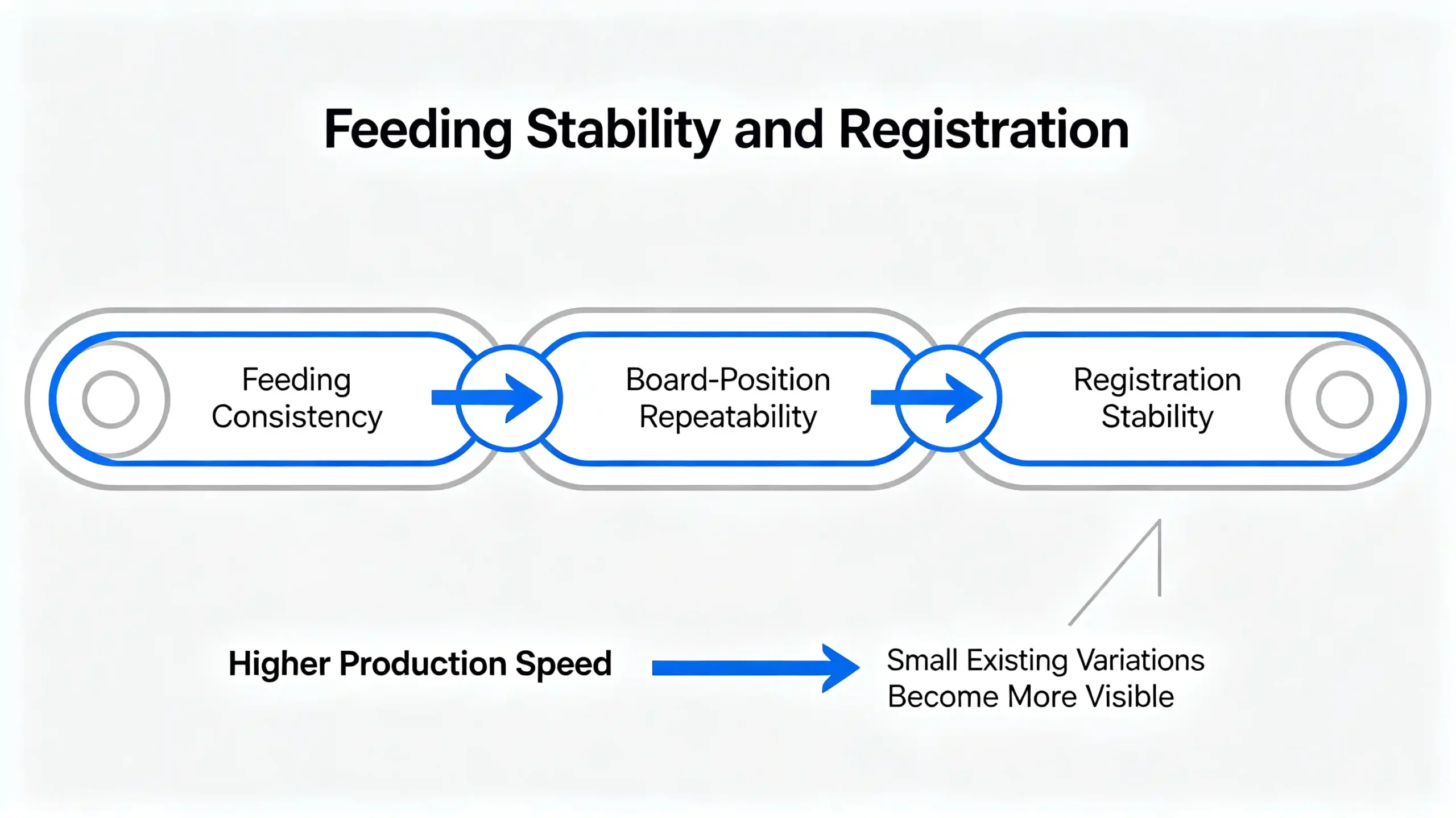
When each board enters the printing section at a consistent position, the printing system has a more stable input condition.
When board position keeps changing, the printing system is working with a changing substrate position.
The relationship can be stated simply:
Feeding Consistency → Board-Position Repeatability → Registration Stability
This does not mean that every registration problem is caused by feeding.
It means:
When diagnosing registration problems, feeding stability is a condition that must be verified first.
Board Position Repeatability Through the Printing Section
Stable board transport does not simply mean that the board reaches the other side of the machine.
It means that each board maintains as much consistency as possible as it passes through critical points in the transport and printing process.
This includes:
- Entry position
- Direction
- Leading-edge condition
- Transport timing
- Repeatability during continuous operation
If these conditions change significantly, print position can change even when the printing-system settings remain unchanged.
Why Higher Speed Can Expose Feeding Weaknesses
As speed increases, the feeding system has less time to perform the required feeding and alignment functions.
Small variations that are not obvious at lower speed can therefore become much easier to see.
For example:
- Slight board slipping can become more obvious
- Position drift can become more visible
- Feeding-timing variation can show up more clearly downstream
- Problems that could previously be managed through frequent operator correction may become difficult to compensate for continuously
High speed should therefore not be understood simply as “running the machine faster.”
The more important point is whether the system can maintain the required stability at the higher production rate.
If print quality also deteriorates as speed increases, you can refer to print quality at higher speeds to compare how different parts of the production system may contribute.
When Feeding Stability Becomes a Machine Design Issue
If reasonable board conditions, appropriate adjustment, and single-variable testing do not eliminate the problem—and the symptoms are clearly linked to mechanical condition, feeding-system design, or the current equipment capability boundary—continued parameter adjustment may no longer be the most effective solution.
For example:
- Different board types continue to show the same problem
- A repeatable stability difference appears between lower and higher speeds
- Certain parameters have to remain at unusually aggressive settings to compensate
- Mechanical inspection identifies an abnormal condition
- Normal adjustment cannot restore the expected repeatability
At this point, the issue may have moved from a machine adjustment problem to an equipment engineering problem.
Build a Repeatable Feeding Adjustment Method
Good setup is not about getting the machine to run correctly once. It is about building a method that can be repeated later.
Record Board Condition, Machine Speed, and Adjustment Settings
Whenever a significant feeding problem occurs, record as much as practical:
- Board type
- Board size
- Board condition
- Current production speed
- Feeding-related settings
- Specific symptom
- What was adjusted
- What changed afterward
These records help turn individual adjustments into a documented production practice.
When a similar problem appears again, operators can determine:
Is this a production condition we have already seen, or is it a new abnormality?
Establish a Stable Operating Range for Recurring Jobs
For products that are produced repeatedly, a stable operating range can gradually be established.
The objective is not to create one fixed value. It is to define:
- Which conditions normally produce stable operation
- Which changes require readjustment
- Which adjustments remain within the normal operating range
- Which changes justify further inspection
This reduces the need to start from zero every time a recurring order is run.
Reduce Operator-Dependent Variation
If only one highly experienced operator can keep feeding stable, the production process still depends heavily on individual experience.
A better situation is to progressively formalize the decisions needed for stable production:
Symptom → Condition Check → Adjustment Variable → Test → Verification
This turns operator experience into a documented and repeatable operating practice rather than leaving it only with one individual.
Know When Mechanical Inspection Is Required
There is a limit to machine adjustment.
If the same problem keeps returning after several reasonable adjustments—especially when the problem shows up as:
- The same symptom across multiple board types
- Repeated problems under similar production conditions
- Increasing dependence on parameter compensation
- A noticeable change in mechanical condition
- An impact on normal production schedule
then the benefit of continued parameter adjustment becomes limited.
The focus should move toward the mechanical condition of the feeding system or the equipment’s engineering capability.
Verify the Adjustment Before Returning to Production
A complete adjustment is not simply changing a parameter and putting the machine back into production.
The full loop is:
Diagnosis → Adjustment → Test → Verification → Decide Whether Further Action Is Required
Run a Controlled Test After Each Adjustment
After changing one main variable, keep other conditions as stable as possible and run a controlled test.
Do not look only at the first board.
Also observe the machine during continuous production and determine whether the problem:
- Has actually disappeared
- Has only weakened temporarily
- Returns after continued running
- Appears again when production speed changes
Only sustained observation can show whether an adjustment is genuinely effective.
Check Feed Position Repeatability
After adjustment, check whether board position remains consistent at critical points in the transport and printing process.
Focus on:
- Leading-edge position
- Lateral position
- Transport direction
- Variation between consecutive boards
- Changes over a period of production
The focus should be on the trend rather than on one individual board.
Confirm Stable Feeding at the Intended Production Speed
If the plant’s target production speed is relatively high, do not validate the adjustment only at low speed and then return directly to normal production.
Confirm the feeding condition at the intended operating point:
Is feeding still stable?
If the system is stable at lower speed but unstable at higher speed, the problem has not been fully resolved.
Continue investigating the system behavior under the higher-speed condition rather than treating the low-speed test as final validation.
When Adjustment Is No Longer the Right Solution
After reasonable diagnosis and single-variable adjustment, if the problem continues to recur or there are clear indications of a mechanical, structural, or equipment-capability issue, stop relying on endless parameter compensation.
A simple decision logic is:
If the problem can be stabilized through normal adjustment, it remains within the production-adjustment range.
If only significant compensation can keep production running temporarily, or the problem quickly returns after adjustment, investigate the system condition further.
If the problem has been linked to a specific mechanical condition, feeding-system design limitation, or equipment capability boundary, the next step is equipment engineering analysis.
This does not automatically mean the machine must be replaced.
The first task is to establish:
Where is the problem actually coming from, and can the existing equipment still resolve it through a reasonable engineering approach?
For a broader view of corrugated carton printing problems, you can also refer to common carton printing problems.
Stable Feeding Starts With the Whole Transport System
Feeding stability on a corrugated flexo printer is not achieved simply by finding the right value for one parameter.
It is closer to a complete production system:
Board Condition → Feeding Settings → Alignment → Contact and Pressure → Transport Timing → Production Speed → Final Verification
If one parameter is repeatedly adjusted to compensate for everything else, the problem may temporarily disappear without the underlying cause ever being identified.
A more reliable approach is to follow the actual board path step by step. Start with board condition, then check feeding, alignment, pressure, timing, and speed. Use single-variable testing, and verify the result under the intended production conditions.
There is also an important manufacturer-level engineering principle to keep in mind:
When one part of the system has to be repeatedly compensated for by another parameter, the real question is often not “How much further should we adjust this parameter?” but “Is the mechanism that should perform this function actually working as intended?”
When normal adjustment and verification can no longer eliminate the problem, and the cause increasingly points to mechanical condition, feeding-system design, or an equipment capability boundary, the next step is equipment engineering evaluation.
The purpose is not to turn every production problem into an equipment purchasing problem. It is to make sure that every adjustment follows a clear diagnostic logic and every upgrade decision is supported by sufficient engineering evidence.

Li Yong
General Manager, Jeytop Industrial Group
I share practical insights on corrugated packaging machinery, production requirements, and equipment selection.