Li Yong | General Manager, Jeytop Industrial Group
I share practical insights on corrugated packaging machinery and production.
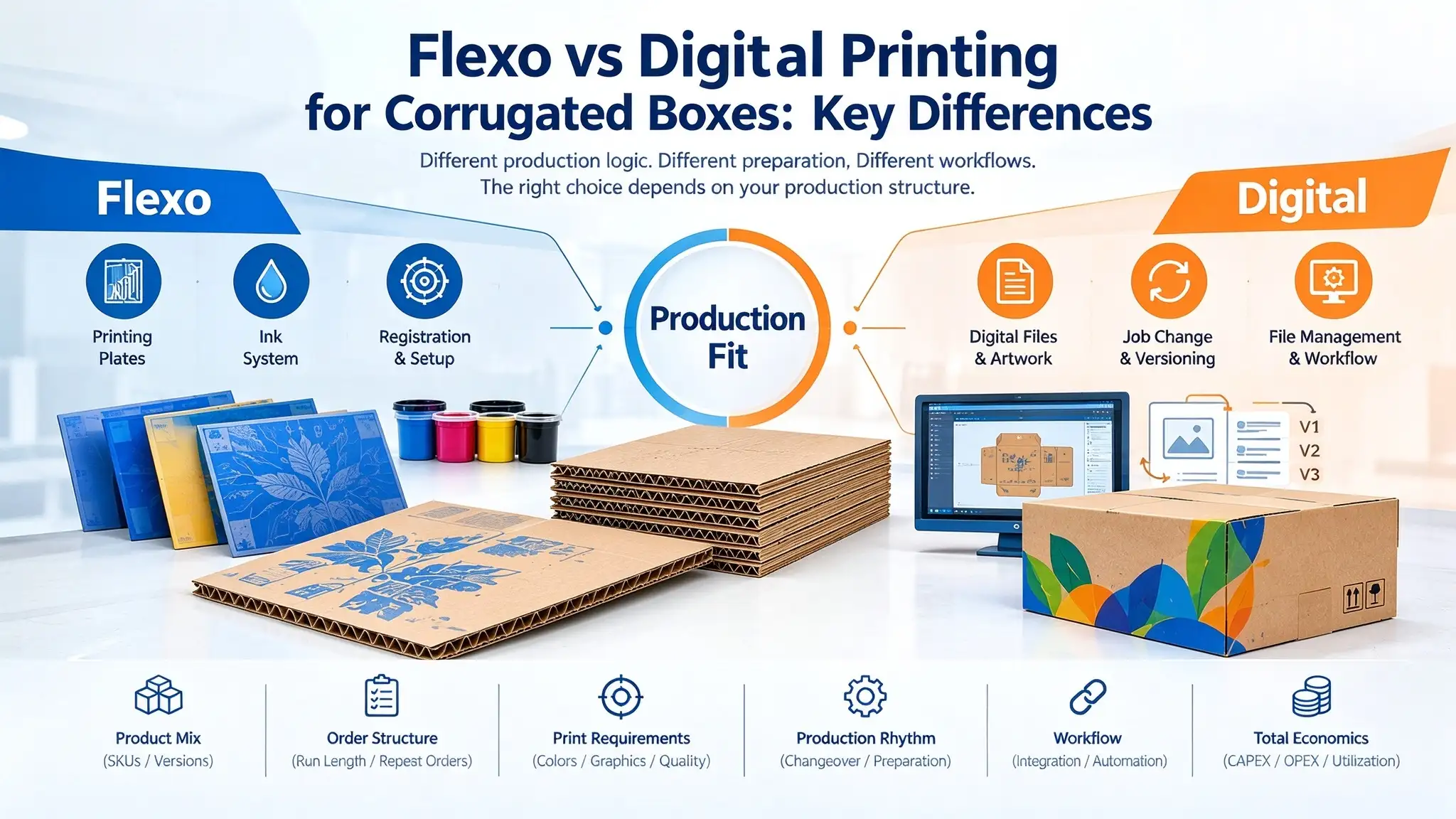
Flexo and digital printing are both established options for corrugated box production. When comparing flexo vs digital printing for corrugated boxes, the key question is not which technology is “more advanced,” but which one better fits the company’s order structure, product mix, and overall production system.
Which technology better fits my order structure, product mix, and overall production system?
Flexo and digital printing differ significantly in production logic, preparation requirements, changeover patterns, order suitability, and overall economics. Comparing only equipment price, rated speed, or cost per sheet can easily lead to a misleading conclusion.
This article provides a practical comparison framework based on production conditions, helping corrugated box manufacturers determine which technology deserves closer evaluation.
The production scenarios below are illustrative and do not represent any specific customer case.
Why Printing Technology Choice Matters for Corrugated Box Production
What Actually Drives the Choice?
The choice of printing technology for corrugated boxes is usually driven by four core factors:
- Product mix — What types of boxes are being produced? How many SKUs and versions are involved? How stable is the product mix over time?
- Order structure — How are order quantities distributed? How many orders are repeat jobs? How frequently do jobs need to be changed?
- Print requirements — How many colors are required? How complex are the graphics? How important are brand consistency and print quality? What are the surface conditions of the corrugated board?
- Production rhythm — How often are jobs changed? How much preparation time is required? How is equipment utilization organized? How well does printing connect with downstream converting?
Together, these factors determine whether flexo or digital printing is worth prioritizing for further evaluation.
Discussing which technology is “better” without considering these conditions has limited engineering value.
Why Rated Speed or Unit Cost Alone Can Mislead
Several common assumptions can distort a technology comparison.
Rated speed does not equal effective output.
A machine’s rated speed does not mean that the same output can be sustained under a company’s actual order structure. Preparation, changeovers, and frequent job changes all affect how efficiently the equipment can be used.
Cost per sheet or box does not equal total cost of ownership.
Plate making, consumables, labor, maintenance, waste, rework, and equipment utilization should all be considered when comparing production economics.
No conventional plate-making cost does not mean every job is more economical digitally.
Digital printing eliminates the traditional plate-making step, but equipment investment, consumables, prepress requirements, production conditions, and workflow still need to be evaluated against the actual order structure.
For this reason, technology selection should be based on the complete production system rather than on any single parameter.
How Flexo and Digital Printing Work for Corrugated Boxes
How Flexo Printing Fits Corrugated Production
Flexographic printing for corrugated boxes uses physical printing plates, printing units, and an ink metering system to apply graphics to the board. Its production organization typically revolves around plate preparation, press setup, and stable production runs.
During preparation and changeover, manufacturers need to consider plate handling, plate mounting, registration, the ink system, and other press adjustments. Once production reaches a stable state, long, repeatable runs can make fuller use of the press’s operating capability.
From an equipment manufacturer’s engineering perspective, evaluating a corrugated flexographic press should not focus only on the specifications of individual printing units. The complete production flow also needs to be assessed, including how these stages work together:
Feeding → Board Transfer → Printing → Changeover → Downstream Converting
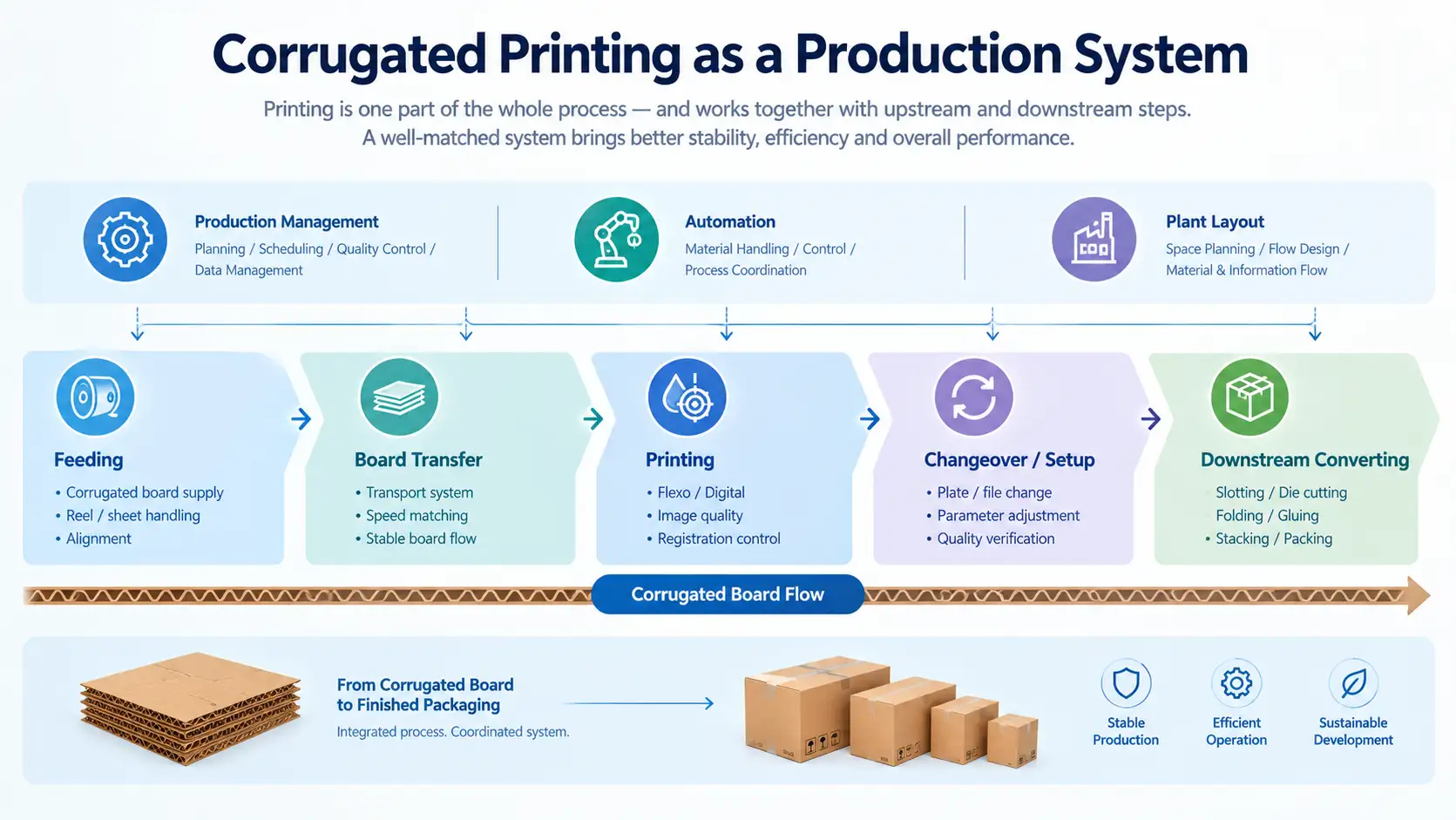
The key question is whether the different stages can operate together reliably as one production system.
Corrugated board also has physical characteristics that differ from relatively flat printing substrates. Board surface conditions, transport stability, impression settings, registration, and coordination between printing units therefore need to be considered when evaluating equipment.
For additional background on the challenges of printing on corrugated substrates, see the Flexographic Technical Association resource:
FTA — What’s So Hard About Printing on Corrugated?
How Digital Printing Fits Corrugated Production
Digital printing uses digital artwork and production files as the input for the printing process and does not require conventional plate making. As a result, it follows a different production workflow when it comes to version changes, file changes, and rapid job changes.
In this article, “digital printing” refers specifically to digital printing workflows used in corrugated board production. Actual machine architecture, feeding method, consumables, and production capability still need to be evaluated on an equipment-by-equipment basis.
When a business handles multiple versions, frequently changing graphics, or orders that require faster job changes, digital printing can reduce some of the preparation associated with traditional plate-based production.
That does not mean every short-run order should automatically be produced digitally.
The equipment’s actual capabilities, order structure, print requirements, consumable costs, and overall workflow still need to be assessed together.
In other words, digital printing can eliminate or reduce some traditional preparation steps, but it does not eliminate the underlying constraints of the production system.
Where the Two Workflows Diverge
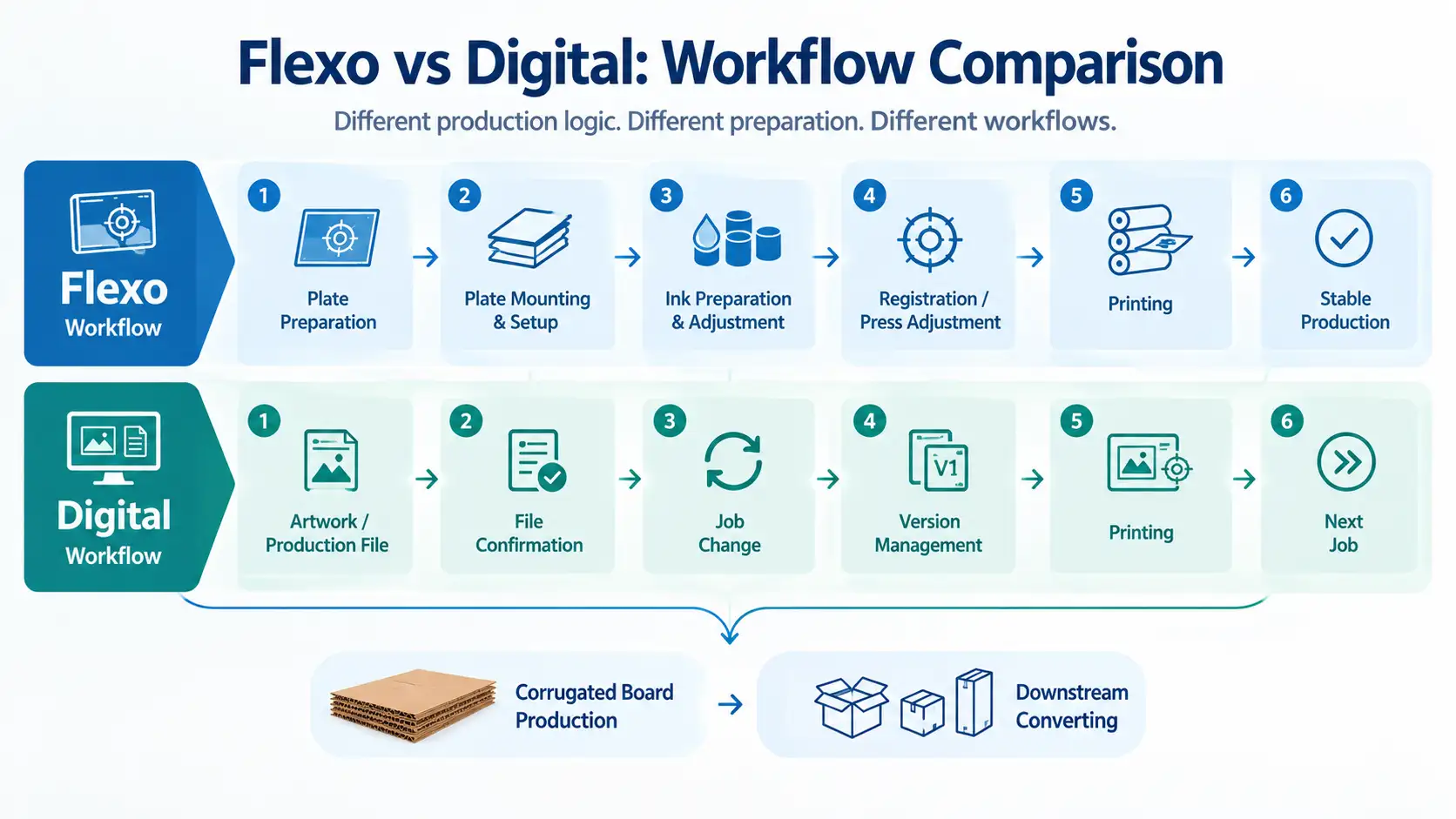
One of the most important differences between flexo and digital printing is how preparation and changeovers are organized.
A flexo workflow commonly involves:
- Plate preparation and management
- Printing unit setup
- Registration and related adjustments
- Ink preparation, adjustment, and cleaning
- Organizing production around long, stable, repeatable runs
A digital workflow typically places more emphasis on:
- Digital artwork and production files
- Job changes
- File management
- Version management
- Rapid changes between orders
The real difference, therefore, is not simply “plates versus no plates.”
It is a difference in how the production process itself is organized.
Flexo vs Digital Printing for Corrugated Boxes: The Key Comparison Factors
Run Length and Order Structure
A technology comparison should not rely only on the simple question of whether an order is “long” or “short.”
A more useful analysis considers:
- How order quantities are distributed
- The proportion of long, medium, and short runs
- Which jobs can be repeated
- How often the same job returns to production
- How frequently jobs are changed
- How tight the delivery schedule is
For example, a corrugated box manufacturer may have a combination of stable repeat orders and rapidly changing small-batch jobs.
Looking only at average order length could hide the actual production structure.
For this reason, run length should always be evaluated together with job mix.
Setup Time and Changeover Requirements
Changeover efficiency directly affects the amount of time available for productive operation.
When comparing flexo and digital printing, it is useful to consider:
- Plate or file preparation time
- Plate mounting, removal, and management
- Ink preparation, adjustment, and cleaning
- Impression settings, registration, and other press adjustments
- File changes and version confirmation
- Trial printing and the time required to return to stable production after a changeover
Flexo preparation is more closely associated with physical plates and press adjustments, while digital preparation is more closely associated with files and job changes.
When changeovers occur frequently, the proportion of total production time consumed by preparation becomes increasingly important.
Product Mix and Versioning
Product mix complexity cannot be described by order length alone.
A corrugated box manufacturer should also consider:
- Number of SKUs
- Number of versions
- Regional versions
- Promotional versions
- Customer-specific versions
- Frequency of artwork changes
- Repeat-order levels
The more complex the product mix becomes, the more important version management, file changes, and preparation methods become.
Digital printing can make version switching more flexible from a workflow perspective. Flexo can also support multi-version production through plate management, production scheduling, and standardized setup procedures.
The key is to determine which production method better matches the company’s actual order structure.
Print Quality and Graphic Requirements
For corrugated box printing, quality requirements should be translated into specific technical criteria that can be evaluated against equipment capability, including:
- Text clarity
- Solid coverage and consistency
- Graphic complexity
- Color consistency
- Brand color requirements
- Suitability for the corrugated board surface
It would be misleading to conclude that digital printing is always better, or that flexo is always better.
The final result depends on the equipment, print configuration, board conditions, and level of production control.
From an equipment engineering perspective, the more reliable approach is to translate the actual graphics and print requirements of the customer’s orders into technical requirements, then compare those requirements with the capability boundaries of the available printing systems.
Production Speed and Overall Productivity
Equipment procurement should compare actual production performance, not a single rated speed.
Evaluation should take into account:
- Theoretical running speed
- Preparation time
- Changeover frequency
- Productive running time
- Equipment utilization
- Job changes
- Integration with upstream and downstream processes
A machine with a high theoretical speed can still deliver a very different effective output when production involves frequent job changes.
The key principle is:
When evaluating equipment, compare actual production performance—not just rated speed.
This is also why an equipment manufacturer needs to evaluate order structure, machine configuration, and process integration together when reviewing a project.
Cost Structure and Total Cost of Ownership
Technology selection should be evaluated from a full life-cycle economic perspective.
Relevant cost factors include:
- Equipment investment
- Plate-making and related preparation costs
- Digital prepress and file-preparation costs
- Ink and other consumables
- Changeover costs
- Labor
- Inventory impact
- Waste and rework
- Maintenance
- Long-term operating costs
At the same time, equipment utilization should be treated as a key production variable because it affects effective output, fixed-cost absorption, and overall production economics.
Utilization is not a direct cost item. It affects how efficiently the equipment investment and operating costs are spread across actual production.
A more useful comparison therefore considers CAPEX, Setup, Consumables, Labor, Maintenance, and Waste, together with Utilization and other production variables that influence economic performance.
The objective is not to assume that one technology must always have a lower cost.
The objective is to determine whether its cost structure fits the company’s own production model.
Matching the Technology to Your Production Needs
When Flexo Deserves Priority Evaluation
Flexo may warrant closer evaluation when the production profile includes:
- A relatively stable product mix
- A high proportion of repeat orders
- The potential to maintain high equipment utilization
- A need for long, stable production runs with relatively few changeovers
- The need to integrate reliably with existing downstream converting
- A production model centered on repeatable, established batch manufacturing
There is no need to define a universal order-quantity threshold.
The relevant question is how well the complete production system fits the technology, not whether a specific order reaches a particular number of sheets or boxes.
When Digital Deserves Priority Evaluation
Digital printing may warrant closer evaluation when the production profile includes:
- Frequent job changes
- A large number of versions
- Significant personalization or regional customization
- Frequent artwork changes
- A need to respond quickly to different orders
- A strong desire to reduce traditional plate-based preparation
Digital printing should not be defined simply as a technology “for short runs.”
The more useful question is whether a digital workflow can address the production challenges created by frequent job and version changes, and whether that flexibility is justified by the equipment and operating costs involved.
When a Mixed Strategy Is Worth Evaluating
Some corrugated box manufacturers handle two very different categories of work:
- Stable, repeatable, relatively large-volume orders
- Highly variable orders with frequent changes, multiple versions, and tight delivery requirements
In such cases, a mixed technology strategy may also be worth evaluating.
For example, orders can be assigned to the production method that best matches their characteristics, allowing stable high-volume jobs and highly variable jobs to follow different workflows where appropriate.
For additional industry background on digital printing in corrugated applications, see:
FEFCO — High Digital Printing on Corrugated Board Workshop
A mixed strategy should therefore be evaluated on the same production data, rather than assumed to be better than a single-technology approach.
A Practical Decision Framework for Corrugated Box Printers
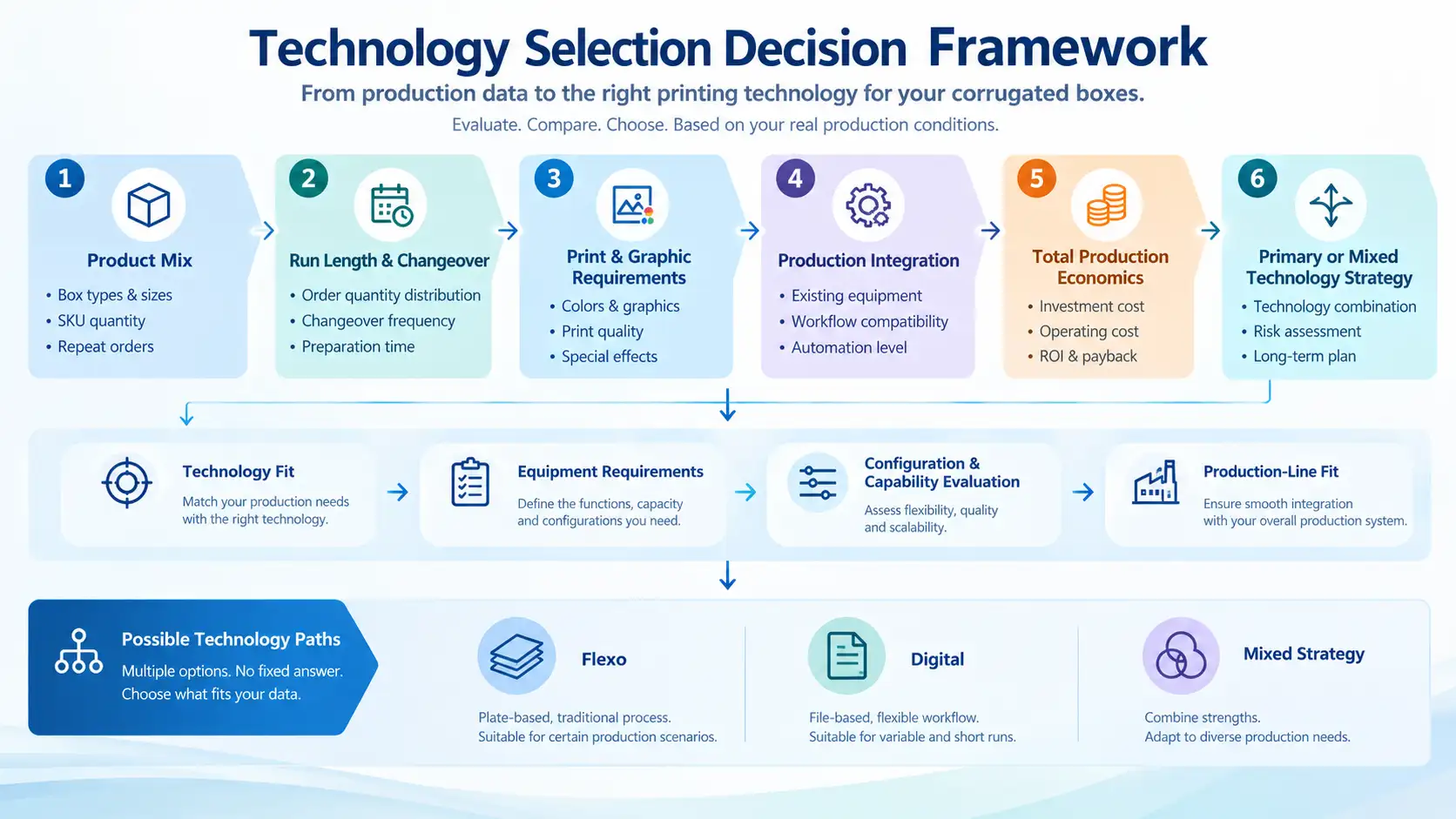
Step 1 — Define Your Product Mix
Start by defining:
- Product types
- Number of SKUs
- Number of versions
- Repeat-order levels
- Main print requirements for different products
You need to understand what the company actually produces before determining what type of printing technology it needs.
Step 2 — Define Run Length and Changeover Patterns
Next, organize:
- Order quantity distribution
- Long-, medium-, and short-run structure
- Order frequency
- Repeat-order percentage
- Changeover frequency
- Current preparation procedures
Do not rush to identify a single “break-even” or “threshold” order volume.
First determine whether the main production constraint is the ability to run for longer stable periods or the ability to change efficiently between jobs.
Step 3 — Define Print and Graphic Requirements
Document:
- Required print quality
- Number of colors
- Graphic complexity
- Brand and artwork requirements
- Corrugated board surface conditions
- Personalization or multi-version requirements
These inputs need to be translated into specific technical conditions that can be evaluated against equipment capability.
Step 4 — Evaluate Production Integration
A printing machine does not operate in isolation.
The evaluation should also consider:
- Existing printing equipment
- Downstream converting equipment
- Level of automation
- Production management processes
- Board conveying and stacking
- Plant space and logistics conditions
These inputs also help define the equipment requirements and how the new press should fit into the broader production system.
For Jeytop, this stage can include technical consulting, plant planning, and production-line configuration, so the equipment discussion can be based on the customer’s actual production conditions rather than on isolated machine specifications.
The objective is not to maximize a single machine parameter.
It is to determine whether the proposed equipment can integrate reliably with the existing production system and support reasonable utilization.
Step 5 — Compare Total Production Economics
Once the production data has been organized, compare the overall economics of the available technology options.
At minimum, consider:
CAPEX + Setup + Consumables + Labor + Maintenance + Waste
At the same time, treat Utilization as a key production variable affecting effective output, fixed-cost absorption, and overall production economics.
Where relevant, the evaluation can be expanded to include:
- Inventory
- Plate management
- Waste and rework
- Long-term expansion requirements
- Equipment upgrade flexibility
The purpose is to evaluate the economics of the complete production model rather than isolate one cost item.
Step 6 — Decide on a Primary or Mixed Technology Strategy
The final step is to determine whether the company should:
- Use flexo as its primary printing technology
- Use digital printing as its primary printing technology
- Use different technologies for different categories of orders
Once flexo appears to be a suitable fit for the production model, the next task is to define the requirements of the corrugated flexographic press itself.
This includes questions such as:
- What press configuration is appropriate?
- What production capacity is required?
- What board and print conditions must the press accommodate?
- How should the press integrate with existing feeding, conveying, and downstream converting systems?
- What level of automation is appropriate for the production model?
The production data collected in the earlier steps provides the basis for this equipment evaluation. Product mix, order structure, board conditions, print requirements, changeover patterns, and downstream processes can all influence the required press configuration and how the equipment should fit into the existing production system.
Jeytop provides technical consulting, plant planning, and production-line configuration for corrugated packaging projects. This allows equipment requirements to be considered in the context of the customer’s production conditions and broader production-line needs.
Once the technology route has been defined, the next stage is to evaluate the specific factors involved in corrugated flexographic press selection, including equipment configuration, production capability, and integration with the rest of the line.
What Information Should You Prepare Before Choosing a Printing Technology?
Production and Order Data
Before comparing technologies, prepare:
- Product mix
- Order-length distribution
- Number of SKUs
- Number of versions
- Changeover frequency
- Monthly or per-shift output
- Repeat-order percentage
- Order lead-time requirements
The more accurately these data reflect the company’s production profile, the more meaningful the technology comparison will be.
These data also become important inputs when moving from technology selection to equipment requirements and production-line planning.
Board and Print Requirements
Also prepare:
- Common corrugated board types
- Board dimensions and key specifications
- Required print colors
- Graphic complexity
- Quality requirements
- Brand and artwork requirements
- Special-order requirements
Different board conditions and print requirements can directly affect both equipment configuration and technology suitability.
Existing Plant and Equipment
The current production environment should also be reviewed, including:
- Existing printing equipment
- Downstream converting equipment
- Automation level
- Conveying systems
- Production management methods
- Plant space and equipment layout
Whether a new machine can integrate smoothly with the existing system is an important part of the purchasing decision.
For an equipment manufacturer, these details can help determine not only which printing technology deserves further evaluation, but also what configuration and production-line arrangement should be considered.
Investment and Expansion Plan
Finally, the technology decision should be considered in the context of the company’s future investment and expansion plans, including:
- Investment budget
- Target production capacity
- Expansion plans
- Long-term production model
- Expected changes in the future product mix
This helps keep the equipment decision aligned with both current and future production needs.
Conclusion
Flexo and digital printing each have production environments in which they may be worth evaluating for corrugated box printing.
The right decision path is not to choose a technology first. It is to define the production model first:
Product Mix → Order Structure → Setup & Changeover → Versioning → Print Requirements → Production Rhythm → Workflow → Overall Economics → Technology Selection
For production profiles characterized by stable, repeatable orders and the potential for high equipment utilization, flexo may warrant further evaluation.
For production profiles characterized by numerous versions, frequent changes, and a strong need for rapid job changes, digital printing may warrant closer evaluation.
When both types of orders exist within the same business, a mixed technology strategy can also be assessed against the same production data.
Before comparing equipment prices, the most useful step is to organize the fundamentals:
Product mix, order structure, capacity requirements, print requirements, changeover patterns, and plant conditions.
These inputs do two jobs: they help determine which printing technology is appropriate to evaluate, and they provide the technical basis for defining the equipment requirements that follow.
Once the technology route has been identified, the next step is to move into equipment configuration, capability evaluation, and production-line fit.
For a corrugated box manufacturer evaluating flexo, Jeytop can support this stage through technical consulting, plant planning, and production-line configuration, using the customer’s production requirements as the starting point for the equipment discussion.
From there, the purchasing process can move into the specific requirements of a corrugated flexographic press—including its configuration, production capability, and integration with the rest of the line.
That keeps the decision sequence clear:Production Data → Technology Fit → Equipment Requirements → Configuration & Capability Evaluation → Production-Line Fit

Li Yong
General Manager, Jeytop Industrial Group
I share practical insights on corrugated packaging machinery, production requirements, and equipment selection.