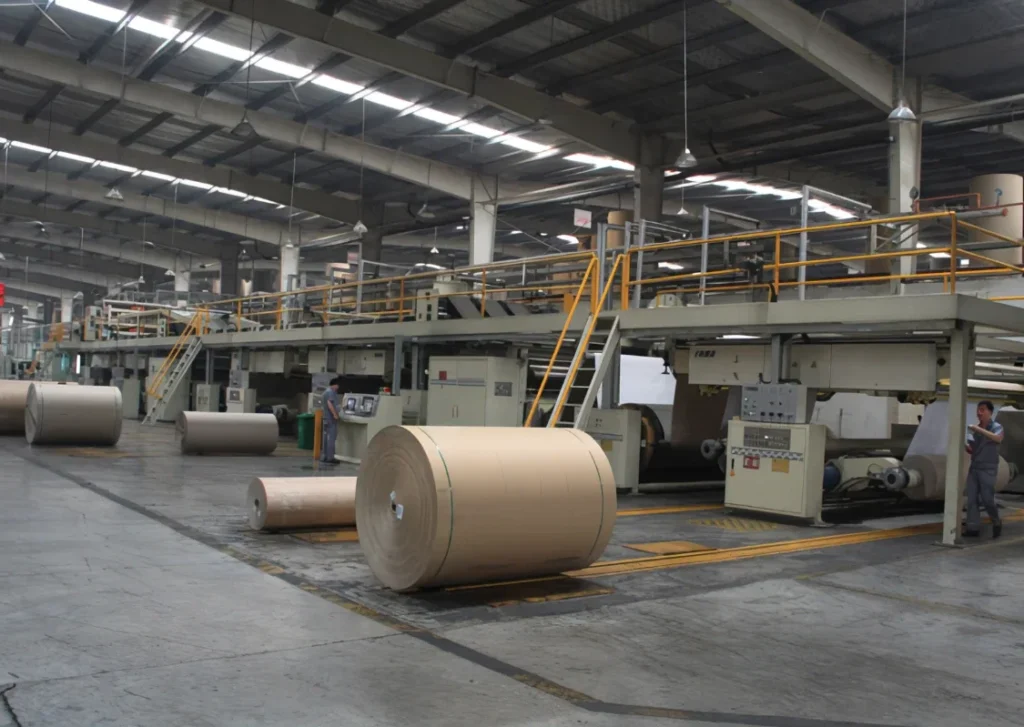
When purchasing a horizontal baler for waste paper or cardboard, most buyers focus on the baling machine itself: compression force, bale size, bale weight and production capacity.
The feeding conveyor is sometimes treated as a secondary component.
In actual operation, however, the conveyor has a direct effect on feeding stability, material handling, maintenance and the overall reliability of the baling line.
For horizontal balers, two common feeding solutions are belt conveyors and chain conveyors.
They are not simply two different ways of moving material. Their structures and suitable working conditions are quite different.
A belt conveyor is generally the better choice for clean, dry and relatively light materials, while a heavy-duty chain conveyor becomes more attractive when the material is wet, heavy, irregular or contaminated with sharp and hard objects.
So which one should you choose?
Let’s look at the differences from the actual working conditions of a waste paper recycling operation.
1. Belt Conveyor vs. Chain Conveyor: What Is the Difference?
The most fundamental difference is the conveying surface.
Belt Conveyor
A belt conveyor uses a continuous flexible belt driven by pulleys.
For horizontal baler feeding systems, common belt materials include:
- PVC belts
- PU belts
- Rubber or rubber-based belts in some heavy-duty applications
The belt provides a relatively smooth and continuous conveying surface.
This makes it particularly suitable for relatively clean paper and cardboard.
Heavy-Duty Chain Conveyor
A heavy-duty chain conveyor, also called a slat conveyor, chain plate conveyor or plate feeder in different industries, uses metal plates or slats connected to chains.
The conveying surface is rigid rather than flexible.
A typical heavy-duty design includes:
- Steel chain plates
- Drive chains
- Sprockets
- Bearings
- Heavy-duty frame
- Side guards
- Drive motor
Because the conveying surface is made from metal plates, it is much better suited to impact and contact with hard materials than a conventional flexible belt.
2. The Most Important Difference: What Material Are You Feeding?
Before choosing a conveyor, don’t start with the question:
“Which conveyor is better?”
Start with:
“What exactly is going onto the conveyor?”
This is the most useful rule when selecting a feeding system for a horizontal baler.
If your material is:
Clean + dry + lightweight → Belt conveyor
Wet + heavy + mixed + sharp contaminants → Heavy-duty chain conveyor
This simple distinction already eliminates many unsuitable configurations.
3. Belt Conveyor: Advantages and Disadvantages
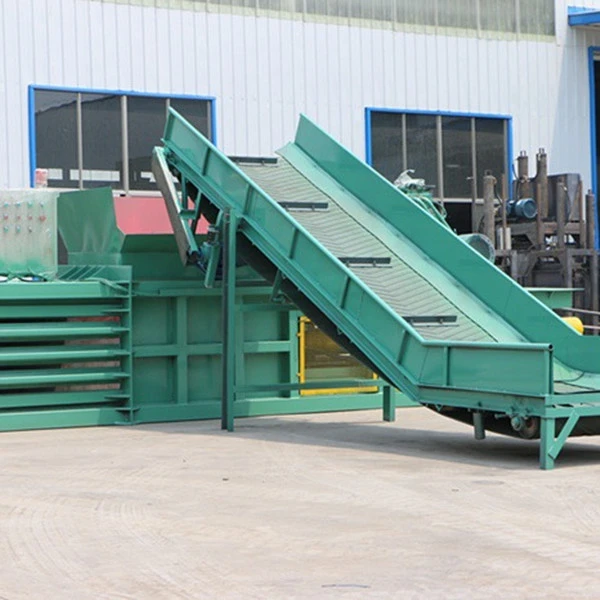
Advantages of Belt Conveyors
3.1 Lower Initial Cost
A standard belt conveyor generally has a simpler structure and lower material cost than a heavy-duty chain conveyor.
For small and medium-sized operations, this can make a significant difference in the initial investment.
If your material is clean and the working conditions are not demanding, spending more on a heavy-duty chain conveyor may not provide a practical benefit.
3.2 Smooth and Quiet Operation
The flexible belt runs continuously over rollers and pulleys.
Compared with a metal chain conveyor, a belt conveyor generally produces less mechanical noise and vibration.
This can be an advantage in facilities where the working environment and noise level are important considerations.
3.3 Suitable for Clean Cardboard and Paper
For applications such as:
- Clean OCC
- Flattened cardboard boxes
- Dry waste paper
- Paper trimmings
- Lightweight packaging waste
a properly selected belt conveyor can provide stable feeding without the need for a heavy-duty metal conveying surface.
3.4 Easy Cleaning
The continuous belt provides a relatively smooth conveying surface.
Dust and small pieces of paper can generally be removed easily during routine cleaning.
4. Belt Conveyor: Where Does It Become a Problem?
The limitations become more obvious when the material becomes heavier, wetter or more contaminated.
4.1 Sharp Objects Can Damage the Belt
Waste paper is not always clean paper.
Depending on the source, it may contain:
- Staples
- Binding wire
- Metal clips
- Hard cardboard edges
- Broken plastic
- Other sharp contaminants
A flexible belt can be cut, punctured or torn by repeated contact with sharp objects.
Once significant belt damage occurs, the damaged section may require repair, while severe damage can require replacement of the belt.
This is one of the main reasons a standard belt conveyor is not the first choice for heavily contaminated waste streams.
4.2 Heavy Impact Can Accelerate Wear
Consider a recycling facility where a forklift or loader drops a large quantity of waste paper directly into the conveyor hopper.
The problem is not only the total weight.
The impact load can be much higher than the normal conveying load.
If this type of loading happens continuously, the conveyor needs to be designed for it.
A standard light-duty belt conveyor is not an ideal choice for severe impact loading.
4.3 Wet Conditions Require Careful Belt Selection
Moisture itself does not automatically make every belt unsuitable.
However, prolonged exposure to water, wet paper, dirt and other harsh conditions can accelerate deterioration depending on the belt material and construction.
For example, an inexpensive belt selected for dry indoor operation should not simply be assumed suitable for a wet recycling environment.
If wet waste paper is a regular part of your operation, the belt material, belt construction and surrounding components should be specifically selected for that environment.
5. Heavy-Duty Chain Conveyor: Advantages and Disadvantages
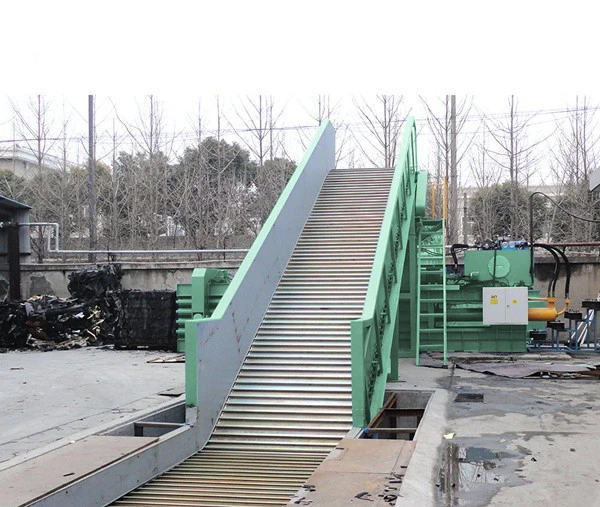
A heavy-duty chain conveyor is designed around a different principle.
Instead of a flexible belt, the material is carried by rigid metal plates or slats driven by chains.
This makes it particularly useful for difficult material-handling conditions.
5.1 Strong Resistance to Impact
The steel conveying surface can tolerate significantly more impact than a conventional flexible belt.
This is particularly useful when:
- Heavy waste is dumped into the hopper
- Large pieces of cardboard are present
- Dense material accumulates
- The feeding process involves forklifts or loaders
For these applications, the additional strength of a heavy-duty chain conveyor can justify its higher initial cost.
5.2 Better Resistance to Sharp and Hard Materials
This is one of the strongest reasons to consider a chain conveyor.
Steel plates are not immune to wear, but they are much less vulnerable to the type of cutting and puncturing that can damage a flexible belt.
Therefore, if your waste paper frequently contains:
- Iron wire
- Staples
- Metal pieces
- Hard cardboard
- Sharp waste
- Heavy contaminants
a properly designed heavy-duty chain conveyor is generally the safer choice.
5.3 Better for Heavy Material
Chain-driven conveying systems are widely used for heavy-duty material handling.
The mechanical drive through chains and sprockets provides positive traction, making this design suitable for demanding loading conditions.
For a horizontal baler handling large volumes of dense or irregular waste, a heavy-duty chain conveyor can provide a more robust feeding solution than a basic belt conveyor.
5.4 Better for Inclined Feeding
Many horizontal balers require the material to be lifted from a lower loading area to a higher feeding hopper.
For inclined applications, a chain conveyor can be equipped with flights or raised conveying plates to help retain material.
A smooth belt can allow loose paper or cardboard to slide backward as the inclination increases.
A belt conveyor can overcome this with cleats or other specialized belt designs, but if the application already involves heavy and irregular material, a chain conveyor is often the more straightforward heavy-duty solution.
5.5 Modular Chain Plates Can Simplify Repairs
This advantage applies specifically to chain conveyors designed with removable modular chain plates.
If one plate is damaged, it may be possible to remove and replace that individual section instead of replacing the entire conveying surface.
However, buyers should confirm the actual construction with the manufacturer.
Not every chain conveyor uses the same removable design.
6. What Are the Disadvantages of a Chain Conveyor?
A heavy-duty design also has trade-offs.
Higher Initial Investment
Steel plates, chains, sprockets and a heavier frame generally make the machine more expensive than a basic belt conveyor.
Therefore, a chain conveyor should not be selected simply because it looks stronger.
If you process clean cardboard in a dry factory and have limited throughput, a belt conveyor may be the more economical solution.
Higher Mechanical Noise
Metal chains, sprockets and plates naturally produce more mechanical noise than a continuous flexible belt.
If noise is an important consideration, a belt conveyor may have an advantage.
More Mechanical Maintenance
A chain conveyor requires attention to components such as:
- Chains
- Sprockets
- Bearings
- Chain tension
- Lubrication points
Regular maintenance is important to prevent excessive wear and maintain stable operation.
More Difficult Cleaning
The joints between chain plates can collect small pieces of paper, dust and other debris.
Therefore, chain conveyors generally require more attention during cleaning than a smooth belt conveyor.
7. Belt Conveyor vs. Chain Conveyor: Direct Comparison
| Factor | Belt Conveyor | Heavy-Duty Chain Conveyor |
|---|---|---|
| Conveying surface | Flexible belt | Steel plates/slats |
| Initial cost | Lower | Higher |
| Noise | Lower | Higher |
| Sharp contaminants | Poorer suitability | Better suitability |
| Heavy impact | Limited by design | Stronger |
| Heavy materials | Light to medium-duty applications | Heavy-duty applications |
| Inclined feeding | Requires suitable belt/cleats | Well suited with flights |
| Wet materials | Requires suitable belt and design | Suitable with appropriate material selection |
| Cleaning | Easier | More involved |
| Maintenance | Belt, rollers, tracking, tension | Chain, sprockets, bearings, lubrication |
| Best application | Clean, dry paper/cardboard | Heavy, mixed or harsh waste |
8. Which Conveyor Should You Choose?
Now we can make the selection more practical.
Choose a Belt Conveyor If:
Your material is clean and dry
For example:
- Clean waste paper
- Dry cardboard
- OCC
- Paper factory trimmings
- Lightweight packaging waste
Your material contains few hard contaminants
If staples, wires and metal pieces are uncommon, the main advantage of a heavy-duty chain conveyor becomes less important.
Your production volume is moderate
For a small or medium operation with controlled feeding, a belt conveyor can provide a good balance between performance and investment.
You want lower initial cost and lower noise
This is where the belt conveyor has a clear advantage.
Recommended belt choice
For dry, relatively clean applications, PU or PVC belts can be considered depending on the required wear resistance, moisture conditions and budget.
Don’t automatically assume PU is always better. The correct belt specification should be matched to the actual application.
9. Choose a Heavy-Duty Chain Conveyor If:
Your waste contains sharp contaminants
If the incoming material regularly contains wires, staples, metal clips or hard sharp pieces, a chain conveyor is generally the safer option.
Your material is heavy or irregular
For dense waste, large pieces and heavy mixed material, the rigid steel conveying surface provides a significant advantage.
Material is frequently dumped from a forklift or loader
High-impact loading is a strong reason to choose a heavy-duty conveyor design.
You process wet or harsh waste
If wet material is a regular part of the operation, a chain conveyor with appropriate corrosion-resistant construction can be more suitable.
For particularly wet or corrosive environments, stainless-steel components may be considered, but the exact grade should be selected according to the actual environment.
You want a heavy-duty feeding system
For a large recycling operation where conveyor downtime can significantly affect production, the greater mechanical robustness of a properly designed chain conveyor can be worth the additional investment.
10. A Practical Selection Chart
You can use the following as a quick guide:
| Working Condition | Recommended Choice |
|---|---|
| Clean, dry cardboard | Belt conveyor |
| Clean waste paper | Belt conveyor |
| Lightweight paper waste | Belt conveyor |
| Limited budget | Belt conveyor |
| Noise-sensitive facility | Belt conveyor |
| Mixed waste paper | Chain conveyor |
| Waste containing staples/wire | Chain conveyor |
| Heavy or irregular waste | Chain conveyor |
| High-impact loading | Chain conveyor |
| Frequent wet material | Chain conveyor with suitable corrosion-resistant design |
| Severe working conditions | Heavy-duty chain conveyor |
This is a more useful way to select the system than simply comparing machine prices.
11. Don’t Forget the Conveyor Structure
When comparing quotations, don’t only ask:
“Is it a chain conveyor or belt conveyor?”
Ask the supplier for the actual specifications.
For a belt conveyor, check:
- Belt material
- Belt thickness
- Belt width
- Drive motor
- Roller construction
- Loading capacity
- Inclination
- Belt tracking system
For a chain conveyor, check:
- Chain plate material
- Chain thickness
- Chain type
- Sprocket material
- Plate connection structure
- Bearing type
- Drive motor
- Inclination
- Maximum loading capacity
- Whether individual chain plates can be replaced
These details can make a significant difference between two machines that are both simply described as “chain conveyor.”
12. The Most Important Rule: Match the Conveyor to the Material
If you only remember one thing from this article, remember this:
Clean and light → Belt
Heavy and harsh → Chain
More specifically:
Dry + clean + lightweight + moderate production
→ Belt conveyor
Mixed + sharp + heavy + high-impact
→ Heavy-duty chain conveyor
Wet + demanding environment
→ Chain conveyor with appropriate corrosion-resistant components
This is not about saying one machine is universally better.
It is about spending money where it actually improves your operation.
Conclusion
A conveyor is an important part of a horizontal baling system, and choosing the wrong type can create unnecessary maintenance and downtime.
A belt conveyor is generally the more economical choice for clean, dry and relatively lightweight paper or cardboard. It offers smooth operation, lower noise and lower initial investment.
A heavy-duty chain conveyor is better suited to demanding conditions where the material is heavy, irregular, contaminated with sharp objects, frequently loaded with high impact or regularly exposed to moisture.
For most buyers, the decision can be simplified to four questions:
1. Is the material clean or mixed?
2. Is it dry or wet?
3. Is it light or heavy?
4. Is the loading gentle or high-impact?
If the answer is mostly clean, dry, light and controlled, a belt conveyor is usually the sensible choice.If the answer is mostly mixed, wet, heavy or high-impact, a heavy-duty chain conveyor is generally the better investment.The goal is not to buy the strongest conveyor availabThe goal is to choose the conveyor that can reliably handle your actual material and working conditions.