If you’ve run a flexo press in a corrugated plant, you know this feeling.
Start of the shift — everything looks good.
Registration holds. Ink lays down clean. No complaints.
Four, five, six hours in, things start going sideways.
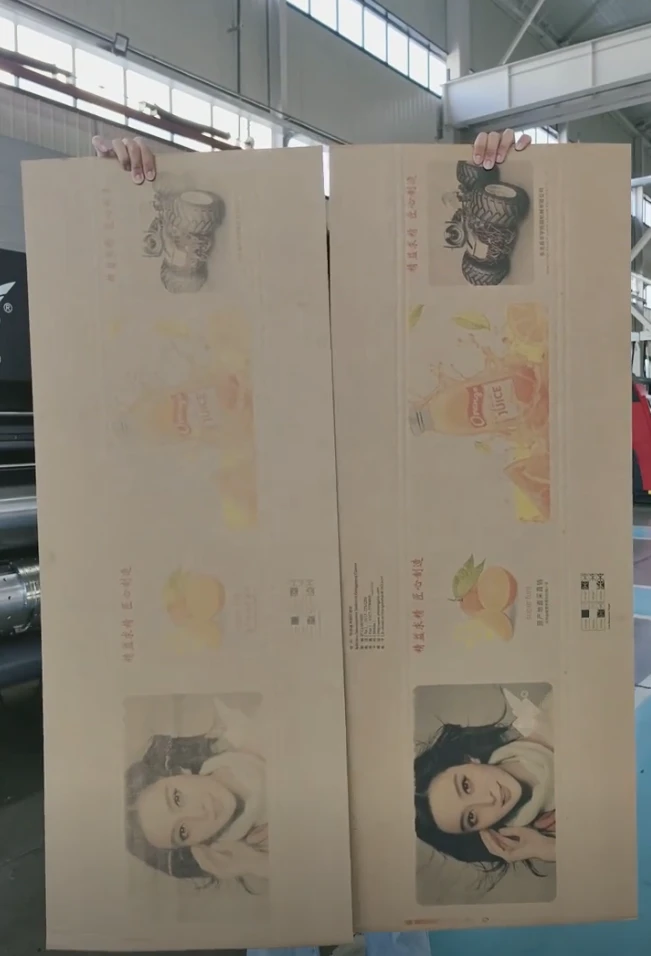
Not all at once. Just small signs.
Density gets a little uneven. Edges aren’t as sharp.
Then smudging. Dirty print. Registration drifting.
And the frustrating part?
You didn’t change a thing.
Same ink. Same settings. Same job.
Where most teams go wrong
The first reaction is almost always the same:
Adjust the ink.
Increase viscosity.
Crank up the dryer.
Slow the machine down.
Sometimes that works — for a little while.
Then the problem creeps back.
That’s usually a sign you’re not fixing the cause. You’re just reacting to what you see on the sheet — not understanding what changed inside the system.
For a deeper look at why ink gets blamed first, see Why Printing Problems Are Often Misdiagnosed as Ink Issues.
What actually changes first on a long run
Here’s what I’ve learned from being in plants when this happens.
The press doesn’t stay the same over hours of running. Things drift — slowly, quietly. By the time you see a defect, the shift already happened.
1. Drying starts falling behind (before you notice it)
This is the first place I look now.
At startup, everything is balanced. Heat is stable. Airflow is clean.
After a few hours, that balance changes.
Airflow weakens — sometimes just from dust buildup inside the system. Heat distribution gets uneven. Moisture doesn’t evacuate as well.
You won’t see it on the control panel. But you’ll see it on the sheet — later.
Quick check I use:
Before touching the ink, grab a sheet coming out of the last unit. Touch it. Lightly rub the surface.
If it’s even slightly tacky, drying is already behind.
Last month, a plant in Vietnam had this exact problem — running double wall board, mid-speed job. After six hours, their solids turned patchy. They changed ink twice — no improvement. The real issue? The dryer couldn’t keep up anymore. Same ink, same settings. But the system had drifted.We’ve seen this pattern before. See a similar case here: Ink Is Not Drying in Flexo Printing — Case Study.
2. The board isn’t the same anymore
This one gets missed all the time.
Corrugated board changes while it sits there.
Stack a pallet next to a running press for a few hours — it warms up. Moisture shifts. Surface behavior changes. The sheets you’re printing at hour six are not the same as the ones at hour one.
What this looks like on press:
One sheet takes ink well. The next one doesn’t. Density starts drifting even though nothing on your control panel moved.
If you don’t consider this, you’ll end up chasing ink settings for no reason.
3. Pressure slowly moves
You may not touch the settings. But that doesn’t mean they stay the same.
Machine warms up. Metal expands. Contact conditions change slightly. Not a big shift — but over time, ink transfer becomes less consistent. Dot gain changes. The print starts to look “off” in a way that’s hard to explain.
4. The machine just runs differently after hours
After running for a long time: vibration increases a little, tension fluctuates a bit more, units don’t stay perfectly in sync.
None of this causes a problem immediately. But combine it with drying drifting and board changing — that’s when things start stacking up.
It’s not one problem — it’s a build-up
This is why quick fixes don’t hold.
What actually happens is more like a chain:
Long run continues → drying slowly falls behind → ink not fully set → transfer becomes inconsistent → operator adjusts ink or speed → system balance gets worse.
By the time you react, you’re already dealing with the result — not the cause.
What to check first (in this order)
If quality drops after a few hours, don’t start with ink.
Step 1
Did the problem appear later in the run?
→ If yes, you’re dealing with system drift.
Step 2
Check drying first — not the temperature reading, the actual result on the sheet. Feel it.
Step 3
Look at the board. How long has it been sitting there? Does it feel different from the start?
Step 4
Only then touch ink or pressure.
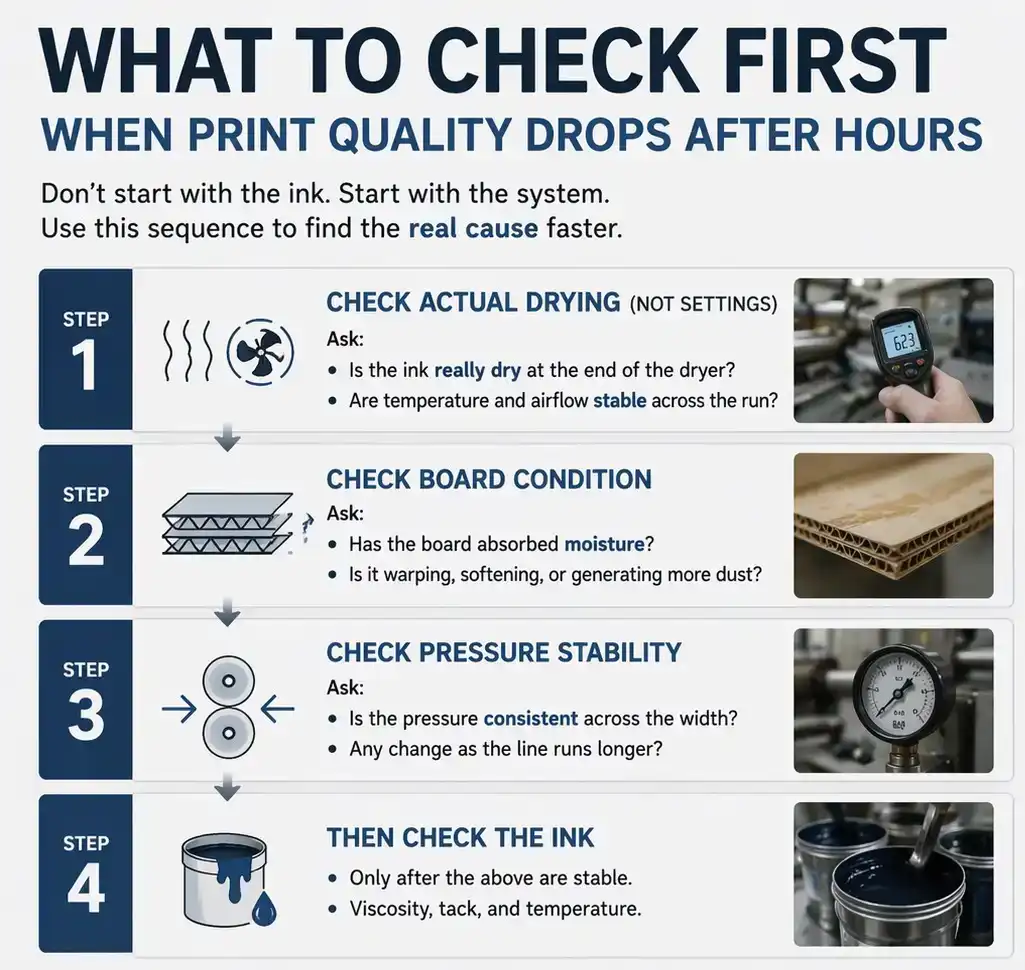
If you start from ink, you’ll go in circles. I’ve seen that happen too many times.
Final thought
These problems don’t show up suddenly. They build.
And if you only look at what’s visible — the sheet, the color, the defect — you’ll always be one step behind.
For technical background on drying systems and industry standards, you can refer to resources from the Flexographic Technical Association.
Need a second opinion?
If you’ve got a job that starts clean and then falls apart later, send me:
- Board type (single/double wall, paper grade)
- Running speed
- What changed during the run (even if you think nothing did)
Usually enough to point you in the right direction.
👉 Send me a message on WhatsApp