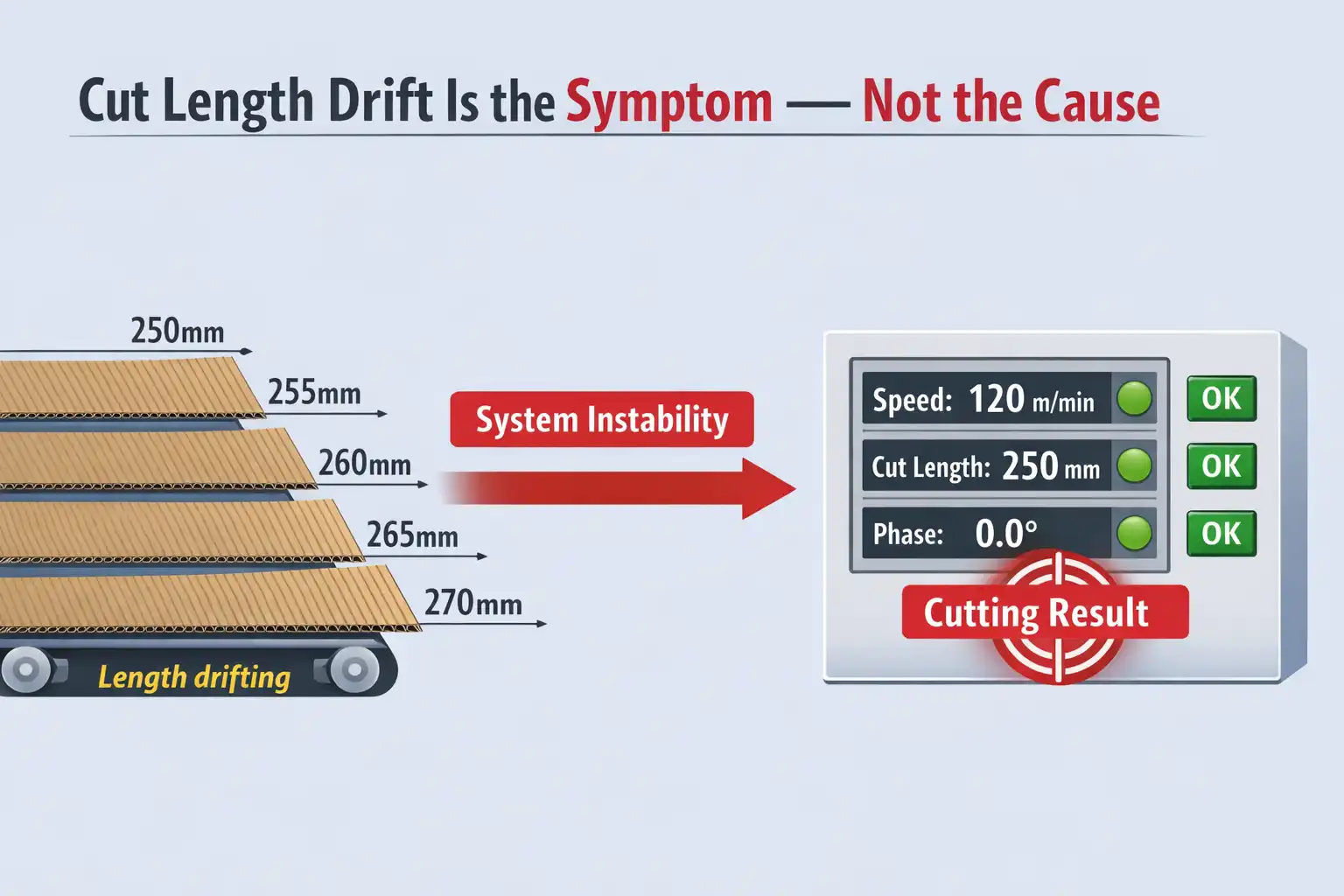
When cut length starts drifting without warning, while all control panel settings — length, speed, phase — remain unchanged, stop your hand before touching the cut-length parameter.
At this moment, one critical understanding must be established immediately:
Cut length drift is rarely caused by the cutting section “cutting wrong.”
It is far more often the first and most honest signal that overall line stability has cracked — and the cutting section is simply the first to report it.
This article does not teach you how to “adjust the length back.”
It answers a far more urgent operational question:
At the moment cut length begins to drift,
which section of the corrugator should be stopped first
to minimize loss and preserve diagnostic evidence?
Minute One: Identify Who Is Actually Drifting
Before taking any action, use one minute to answer this core question:
Is the cutting section generating the error —
or is upstream instability already present, with the cutter faithfully executing a wrong rhythm?
Quickly observe three things.
1. What does the drift look like?
- Continuous, smooth drift in one direction
→ Strongly suggests a systemic, cumulative error. - Sudden jumps, oscillation, poor repeatability
→ More likely a synchronization, transmission, or response fault.
2. Does the drift synchronize with other changes?
- Does it appear together with subtle speed fluctuations?
- Is it accompanied by visible tension changes — flutter, slack, or uneven board spacing?
3. What does the cut edge look like?
- Clean, sharp edges with unstable length
→ The problem is very likely upstream. - Frayed, torn, or rough edges
→ The cutting section itself may be directly involved.
Fast conclusion:
If you see continuous drift + clean cut quality, suspect upstream first — not the cutter.
Minute Two: A Non-Negotiable Rule
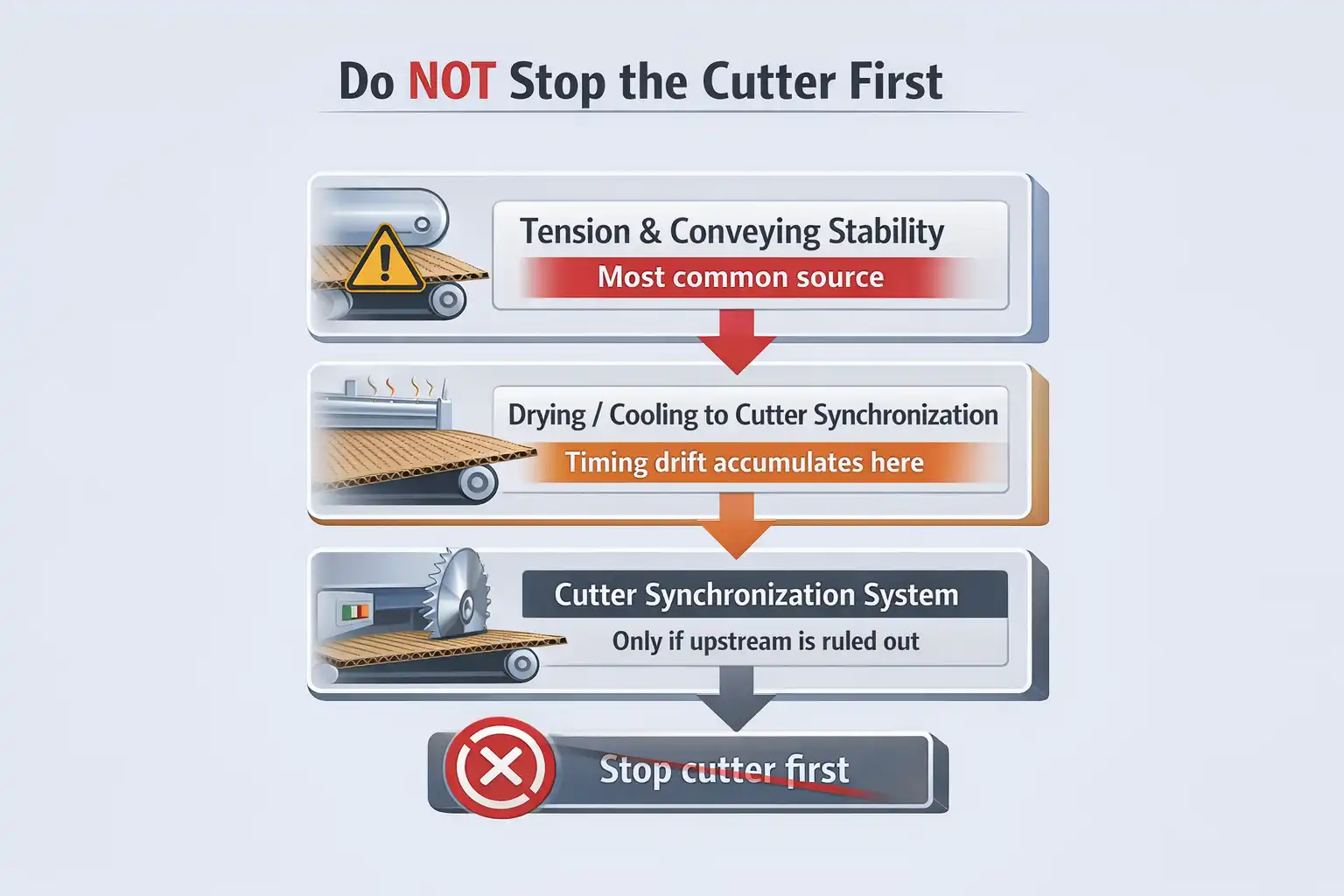
Never Stop the Cutting Section First
This is the most important correction this article makes:
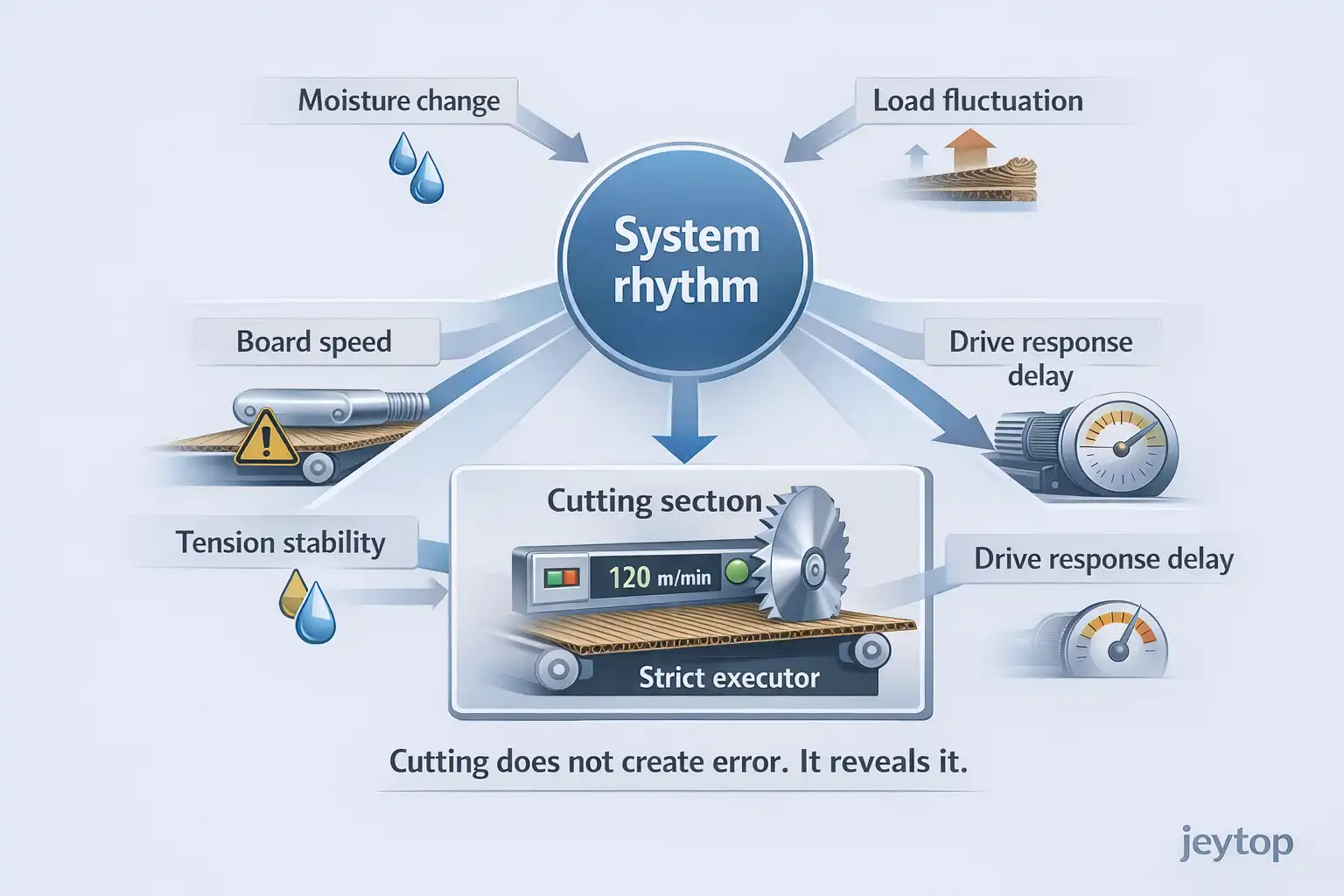
The cutting section is almost never the creator of length error —
it is the final amplifier of upstream instability.
Why stopping the cutter first is dangerous:
- The cutter is a strict executor.
It cuts exactly where the board is at the command moment — nothing more. - It is also a perfect mirror.
It cannot correct upstream position or speed errors; it only converts them into precise length deviation.
If you stop the cutting section first:
- You freeze the result while allowing the cause to continue.
- You destroy time correlation, making root-cause diagnosis far harder after restart.
- You risk secondary faults — accumulation, congestion, or tension shock.
Build this mental model firmly:
Length is not created by the cutter.
It is fed to the cutter by upstream rhythm.
Minute Three: Where You Should Stop First
Correct stop decisions follow one rule:
Trace the error upstream.
Stop where the error is being generated — not where it is being displayed.
Follow this priority order.
First Priority: Tension and Conveying Stability Loss
Typical signals:
- Displayed speed remains constant, but board spacing visibly changes.
- Pre-cutter conveying rhythm becomes uneven.
- Boards show subtle forward-back “creep” before entering the cutter.
Core logic:
Length drift is a time-position error.
The most common root cause of time error is unstable tension or conveying synchronization.
Second Priority: Dryer–Cutter Rhythm Lock Failure
Typical signals:
- Length setpoint is correct.
- Actual cut position drifts progressively forward or backward.
- Drift accumulates over time.
Core logic:
Modern cutting does not measure length physically —
it cuts at a time-synchronized trigger point tied to line speed.
If that time reference drifts, length error is mathematically unavoidable.
Third Priority (Last): Cutter Synchronization Reference Itself
Only consider this when evidence is clear:
- Repeated commands produce inconsistent knife positions.
- After excluding upstream factors, cut length becomes random.
- Length drift and cut quality deteriorate simultaneously.
Only then should you investigate encoder feedback, servo response, or mechanical coupling.
Minute Four: Three Instinctive Reactions That Must Be Prohibited
❌ Immediately adjusting the cut length parameter
→ You mask process error by modifying the result, losing the only true reference.
❌ Changing line speed repeatedly “to feel it out”
→ Speed is the system’s heartbeat. Changing it disturbs heat, glue, tension, and synchronization at once.
❌ Continuing to run while compensating under complaint pressure
→ Chasing results under stress is how small instability becomes systemic failure.
Minute Five: The Only Output That Matters
After five minutes, you do not need any new parameter values.
You must deliver a decision-level conclusion:
- “Current length drift originates from unstable line synchronization/tension, with the cutter passively amplifying the error.”
Or, only with strong evidence:
- “Current drift is confirmed to originate from cutter synchronization reference loss.”
That conclusion determines everything next:
- Controlled continuation or immediate full stop?
- On-site correction or escalation to system-level investigation?
Final Reminder
Cut length drift is never the cutter “cutting the wrong place.”
It is the production system stating — with absolute precision:
Our previously matched operating rhythm has shifted.
Mature cutting management is not defined by how fast length is adjusted after deviation —
but by this capability:
When the first out-of-spec board appears,
can you stop the section creating the error —
instead of the section reporting it?