Cardboard thickness is an important specification when selecting packaging materials. It affects the rigidity, cushioning performance, stacking behavior, printing quality, and converting performance of a carton or box.
However, cardboard does not have one fixed thickness. Its thickness varies depending on the material type, board construction, flute profile, paper grades, and manufacturing process. For example, single-wall, double-wall, and triple-wall corrugated boards have different thickness ranges, while solid paperboard and chipboard follow different thickness specifications.
So, how thick is corrugated cardboard? What is the typical thickness of single-wall, double-wall, and triple-wall board? How does chipboard thickness compare, and what is the relationship between thickness, GSM, and strength?
This guide provides practical cardboard thickness charts in millimeters and inches, covering different corrugated board constructions and solid chipboard (greyboard). It also explains how to measure cardboard thickness and choose the right material for different packaging applications.
1. What Is Meant by Cardboard Thickness?
Cardboard thickness refers to the distance between the two outer surfaces of a paper-based board, measured perpendicular to the board surface. It is usually expressed in millimeters (mm), inches, or points (pt), depending on the material and measurement system.
In this guide, cardboard thickness refers to the finished thickness of the board itself, rather than the thickness or grammage of an individual paper layer.
For corrugated cardboard, this means the total thickness of the finished board, including its linerboards and fluted medium. For solid paperboard, such as chipboard or greyboard, it means the thickness of the solid board without any corrugated flutes.
These materials have different structures and thickness ranges, so they need to be considered separately. The following sections cover corrugated cardboard, including single-face, single-wall, double-wall, and triple-wall constructions, as well as solid chipboard.
2. Different Types of Cardboard and Their Thickness
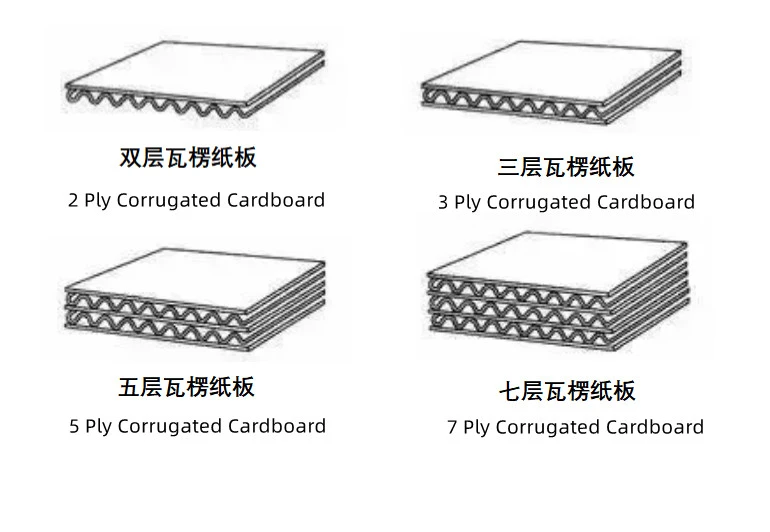
In packaging, the term cardboard is commonly used to describe several types of paper-based materials. Their structures and applications are different, which also affects how their thickness is measured.
2.1 Single-Face Corrugated Board (2-Ply)
Single-face corrugated board consists of one flat linerboard bonded to one layer of fluted paper. It has only one flat paper surface, while the other side has an exposed corrugated flute structure.
Unlike conventional single-wall corrugated board, single-face material does not have a second linerboard covering the exposed flutes. Therefore, it is generally supplied in rolls or sheets and is not normally used directly as a complete carton wall.
Common applications include:
- Wrapping and protecting irregularly shaped products.
- Cushioning fragile items during transportation.
- Protective liners and separators inside packaging.
- Edge and corner protection.
- Protective pads between products.
Its flexible structure makes it useful for wrapping products with different shapes. Its thickness depends mainly on the flute profile and the linerboard used.
2.2 Single-Wall Corrugated Board (3-Ply)
Single-wall corrugated board consists of one fluted medium bonded between two flat linerboards. It has three paper layers in total.
The two linerboards cover both sides of the fluted medium, forming a complete corrugated board suitable for carton production.
Different flute profiles provide different finished board thicknesses and packaging characteristics. Common applications include shipping cartons, retail packaging, and general-purpose corrugated boxes.
2.3 Double-Wall Corrugated Board (5-Ply)
Double-wall corrugated board consists of two fluted mediums separated and covered by three linerboards. It has five paper layers in total.
The two flute profiles can be combined to achieve different board thicknesses and performance characteristics. Double-wall board is commonly used for heavier shipping cartons, export packaging, and industrial packaging.
2.4 Triple-Wall Corrugated Board (7-Ply)
Triple-wall corrugated board consists of three fluted mediums and four linerboards, making seven paper layers in total.
It is a heavy-duty corrugated construction used for large or heavy products that require additional packaging support. Depending on the board grades and box design, it may be considered as an alternative to certain wooden packaging solutions.
2.5 Solid Paperboard and Chipboard (Greyboard)
Solid paperboard has a dense, compact structure without the fluted medium found in corrugated board.
Chipboard, also known as greyboard in many packaging markets, is a type of solid recycled paperboard. It is commonly used as the structural core of rigid gift boxes, cosmetic boxes, book covers, and packaging inserts.
Unlike corrugated cardboard, chipboard does not provide cushioning through fluted structures. Its thickness is usually specified in millimeters or points (pt), particularly in North American markets.
For rigid boxes, the chipboard is often covered with printed or decorative paper. The chipboard itself is generally used for structural support rather than direct printing.
3. Corrugated Cardboard Thickness Chart
Corrugated cardboard thickness depends on the number of paper layers, flute profiles, paper grades, and manufacturing conditions.
An important distinction is the difference between flute height and finished board thickness:
- Flute height refers to the height of the corrugated structure formed by the fluting medium.
- Finished board thickness refers to the total thickness of the completed board, including the linerboards and fluted medium or mediums.
For example, a single-wall A-flute board has a flute height of approximately 4.5–5.0 mm, while its finished thickness is typically around 4.5–5.5 mm. These measurements describe different aspects of the board and should not be treated as interchangeable.
The following charts provide typical reference ranges for different corrugated board constructions. Actual thickness may vary depending on paper grammage, moisture content, corrugator pressure, flute formation, and bonding conditions.
3.1 Single-Face Corrugated Board Thickness (2-Ply)
Single-face corrugated board has one linerboard and one fluted medium. Because one side of the flute remains exposed, its finished structure differs from conventional three-layer single-wall board.
It is commonly supplied in rolls or sheets for wrapping, cushioning, protective lining, and edge protection.
The finished thickness varies according to the flute profile and linerboard. Since there is no second linerboard, its thickness should not be assumed to be the same as that of a three-layer board using the same flute.
3.2 Single-Wall Corrugated Cardboard Thickness (3-Ply)
Single-wall corrugated board contains one fluted medium between two flat linerboards. The flute profile is one of the main factors determining its finished thickness.
| Flute Type | Reference Flute Height (mm) | Typical Finished Board Thickness (mm) | Typical Finished Board Thickness (inches) | Features and Common Applications |
|---|---|---|---|---|
| A Flute | 4.5–5.0 | 4.5–5.5 | 0.1772–0.2165 | Relatively high flute profile; commonly considered for fragile products requiring cushioning |
| C Flute | 3.5–4.0 | 3.5–4.5 | 0.1378–0.1772 | Balanced general-purpose construction for shipping cartons |
| B Flute | 2.5–3.0 | 2.5–3.5 | 0.0984–0.1378 | More flutes per unit length and a relatively flat surface; commonly used for printed cartons |
| E Flute | 1.1–2.0 | 1.5–2.0 | 0.0591–0.0787 | Thin board with a relatively fine surface for retail and printed packaging |
| F Flute | 0.6–1.2 | 1.0–1.2 | 0.0394–0.0472 | Microflute for gift boxes, fine food packaging, and small cartons |
A, C, and B flutes are commonly used in transport and shipping cartons, while E and F flutes are often selected for thinner packaging and applications requiring finer printing surfaces.
The appropriate flute depends on the product weight, box dimensions, stacking requirements, paper grades, and transport conditions.
G flute is another microflute profile, thinner than F flute. It is mainly associated with fine-printing and display packaging and is less commonly discussed as a separate load-bearing construction in conventional three-, five-, and seven-layer shipping board.
3.3 Double-Wall Corrugated Cardboard Thickness (5-Ply)
Double-wall corrugated board contains two fluted mediums and three linerboards. Its finished thickness depends on the combination of the two flute profiles.
| Flute Combination | Typical Finished Board Thickness (mm) | Typical Finished Board Thickness (inches) | Features and Common Applications |
|---|---|---|---|
| BC | 5.90–6.80 | 0.2323–0.2677 | Common combination balancing printing quality and stacking strength |
| AB | 7.00–7.80 | 0.2756–0.3071 | Greater cushioning; commonly considered for large or fragile products |
| AC | 8.20–9.00 | 0.3228–0.3543 | Strong cushioning and protection for heavy goods and long-distance transportation |
| BE | 3.40–4.00 | 0.1339–0.1575 | With E flute on the outside, provides a finer printing surface for electronics and gift packaging |
| EC | 4.60–5.20 | 0.1811–0.2047 | Combines moderate cushioning with relatively good printing performance |
| AE | 5.80–6.40 | 0.2283–0.2520 | A specialized combination for customized packaging requirements |
| AA | 9.20–10.00 | 0.3622–0.3937 | Very thick construction, commonly considered for heavy-duty cushioning pads |
| EE | 2.20–2.80 | 0.0866–0.1102 | Double microflute construction with a fine surface for detailed printing |
Different flute combinations provide different balances of board thickness, cushioning, stacking performance, and printing quality.
For example, BC board is a common double-wall construction that balances printing characteristics and stacking strength. AB and AC combinations are thicker and may be considered when greater cushioning is required. BE and EE are thinner constructions that can be useful when a finer printing surface is important.
3.4 Triple-Wall Corrugated Cardboard Thickness (7-Ply)
Triple-wall corrugated board consists of three fluted mediums and four linerboards. It is used for heavy-duty packaging, particularly for large industrial products and equipment.
| Flute Combination | Typical Finished Board Thickness (mm) | Typical Finished Board Thickness (inches) | Features and Common Applications |
|---|---|---|---|
| ABC | 10.50–11.50 | 0.4134–0.4528 | A widely used triple-wall combination for automotive parts and large equipment |
| BCB | 7.00–7.80 | 0.2756–0.3071 | Good stiffness; suitable for printed outer cartons, with relatively less cushioning |
| BAB | 9.30–10.10 | 0.3661–0.3976 | Outer B flute provides a relatively flat printing surface, while the A flute in the middle contributes cushioning |
| ACA | 12.80–13.80 | 0.5039–0.5433 | Thick construction for heavy and fragile industrial components requiring cushioning |
| AAA | 13.80–15.00 | 0.5433–0.5906 | Very thick construction for heavy-duty cushioning and specialized packaging; may be considered as an alternative to wooden packaging |
| ACC | 10.40–11.40 | 0.4094–0.4488 | Considered for heavy goods requiring stable stacking and industrial packaging |
| EBC | 7.00–7.80 | 0.2756–0.3071 | Outer E flute provides a finer printing surface for heavier retail products |
| BBC | 8.20–9.00 | 0.3228–0.3543 | Used where stacking compression performance and warehouse storage are important |
Triple-wall board is commonly considered for large machinery, industrial components, automotive parts, and other heavy products.
Its flute combination can be selected according to the required balance of thickness, cushioning, printing quality, and stacking performance.
However, a thicker triple-wall board does not automatically guarantee a specific load-bearing capacity. The performance of the finished package also depends on paper grades, liner strength, flute structure, box dimensions, joint design, moisture conditions, and stacking requirements.
3.5 How Do Different Flute Combinations Affect Board Thickness?
When two or three flute profiles are combined, the finished board thickness is influenced by the height of each fluted structure, the linerboards, and the manufacturing process.
The finished thickness is not simply the sum of the nominal flute heights. The linerboards also contribute to the total thickness, while corrugating pressure, paper properties, and bonding conditions can affect the final measurement.
For example, BC double-wall board combines B and C flutes. Its finished thickness is typically around 5.90–6.80 mm in the reference range above. This value describes the complete five-layer board, not just the combined flute heights.
The outer flute can also influence the surface characteristics of the finished board. B and E flutes are often selected for applications requiring a relatively flat printing surface, while larger flute profiles may be considered when cushioning is a greater priority.
When ordering corrugated board, specify the complete flute combination and required finished board thickness. If the board will be printed, also confirm the outer flute profile and linerboard requirements.
4. Chipboard Thickness Chart (Greyboard)
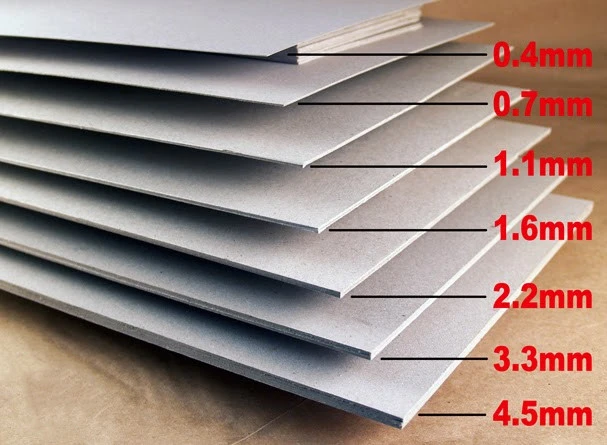
Chipboard, also known as greyboard, is a solid paperboard commonly used in rigid packaging. Unlike corrugated cardboard, it contains no fluted medium.
Its thickness is often specified in points (pt) in North America, while millimeters are widely used in other markets.
One point equals 0.001 inch.
Conversion formula:
1 pt = 0.001 inch = 0.0254 mm
The following chart provides common chipboard thickness references and typical applications.
| Thickness (pt) | Thickness (inch) | Thickness (mm) | Typical Applications |
|---|---|---|---|
| 14 | 0.014 | 0.36 | Lightweight inserts and backing cards |
| 18 | 0.018 | 0.46 | Dividers and thin protective pads |
| 20 | 0.020 | 0.51 | Standard inserts and lightweight wrapped boxes |
| 24 | 0.024 | 0.61 | Lightweight chipboard for small gift box inserts |
| 28 | 0.028 | 0.71 | Moderately rigid jewellery box cores |
| 32 | 0.032 | 0.81 | Cosmetic rigid box cores |
| 40 | 0.040 | 1.02 | Common rigid box core thickness |
| 50 | 0.050 | 1.27 | Gift boxes and book covers |
| 60 | 0.060 | 1.52 | Thicker gift boxes and picture-frame backing |
| 80 | 0.080 | 2.03 | Large gift boxes and hard book covers |
| 100 | 0.100 | 2.54 | Heavy display boxes and thick protective pads |
The right chipboard thickness depends on the size and structure of the finished box, the required rigidity, and the type of product being packaged.
For example, a small jewellery box may use thinner chipboard, while a larger rigid gift box may require a thicker board to maintain its shape.
Some approximate relationships between chipboard thickness and grammage are shown below:
| Chipboard Thickness | Approximate GSM |
|---|---|
| 40 pt | 800–900 gsm |
| 60 pt | 1,050–1,200 gsm |
| 80 pt | Around 1,400 gsm |
These GSM values are approximate references, not fixed conversions. Actual grammage varies with the density, composition, and manufacturing characteristics of the board.
When purchasing chipboard, confirm both thickness and grammage with the supplier if both specifications are important to the application.
5. Cardboard Thickness vs. GSM vs. Strength
Thickness, GSM, and strength are three different specifications. They are related, but they cannot be used interchangeably.
5.1 What Is GSM?
GSM stands for grams per square meter. It measures the weight of paper or paperboard per unit area.
For example, 150 gsm paper weighs 150 grams per square meter.
In corrugated board production, different paper layers may have different GSM values:
- Linerboard: The flat paper layers on the outside and inside of corrugated board.
- Fluting medium: The paper formed into the corrugated arches between the liners.
The total grammage of corrugated board depends on the grammage of all the paper layers, as well as the additional paper consumed when the medium is fluted.
Therefore, the GSM of an individual linerboard should not be confused with the total GSM of finished corrugated board.
5.2 Cardboard Thickness and GSM Reference Chart
The following table provides approximate thickness references for paper and paperboard at different grammage levels.
| GSM | Approximate Thickness (mm) | Approximate Thickness (inch) |
|---|---|---|
| 300 | 0.38 | 0.0150 |
| 400 | 0.50 | 0.0197 |
| 600 | 0.75 | 0.0295 |
| 800 | 1.00 | 0.0394 |
| 1,000 | 1.25 | 0.0492 |
| 1,500 | 1.90 | 0.0748 |
| 2,000 | 2.50 | 0.0984 |
These figures are approximate reference values, not a universal GSM-to-thickness conversion formula.
Two boards with the same GSM may have different thicknesses because their fiber composition, density, compression, coating, and manufacturing processes are different.
For this reason, both GSM and thickness should be checked when specifying packaging materials.
5.3 Does Thicker Cardboard Mean Stronger Packaging?
Not necessarily.
A thicker board may provide greater structural depth or cushioning, but thickness alone does not determine how much weight a carton can carry or how well it will withstand stacking and impact.
For corrugated packaging, important strength-related properties include:
- ECT (Edge Crush Test): Measures the resistance of corrugated board to edgewise compression. It is commonly used to evaluate the board’s contribution to box stacking performance.
- BCT (Box Compression Test): Measures the compression resistance of a complete box under specified testing conditions.
- Bursting strength: Measures the pressure required to rupture the board under a specified test method.
- Cobb value: Measures the amount of water absorbed by the paper or board surface under specified test conditions.
A thicker board with lower-strength paper may perform worse than a thinner board made with stronger paper grades.
When selecting packaging material, consider thickness together with paper grades, ECT, box dimensions, product weight, stacking height, and transport conditions.
6. Cardboard Thickness Conversion: mm, cm, Inches and pt
Cardboard thickness may be specified in different units depending on the country, supplier, and material type.
The following conversions are useful when comparing specifications.
| Unit | Conversion |
|---|---|
| 1 mm | 0.1 cm |
| 1 mm | 0.03937 inches |
| 1 cm | 10 mm |
| 1 inch | 25.4 mm |
| 1 pt | 0.001 inch |
| 1 pt | 0.0254 mm |
| 1 inch | 1,000 pt |
For example:
- 3 mm = 0.1181 inches
- 5 mm = 0.1969 inches
- 6 mm = 0.2362 inches
- 10 mm = 0.3937 inches
- 40 pt = 1.016 mm
- 80 pt = 2.032 mm
For corrugated cardboard, millimeters and inches are commonly used to specify the finished board thickness. For chipboard, points may also be used, especially in North American specifications.
Always confirm the unit when comparing quotations or technical specifications from different suppliers.
7. How to Measure Cardboard Thickness
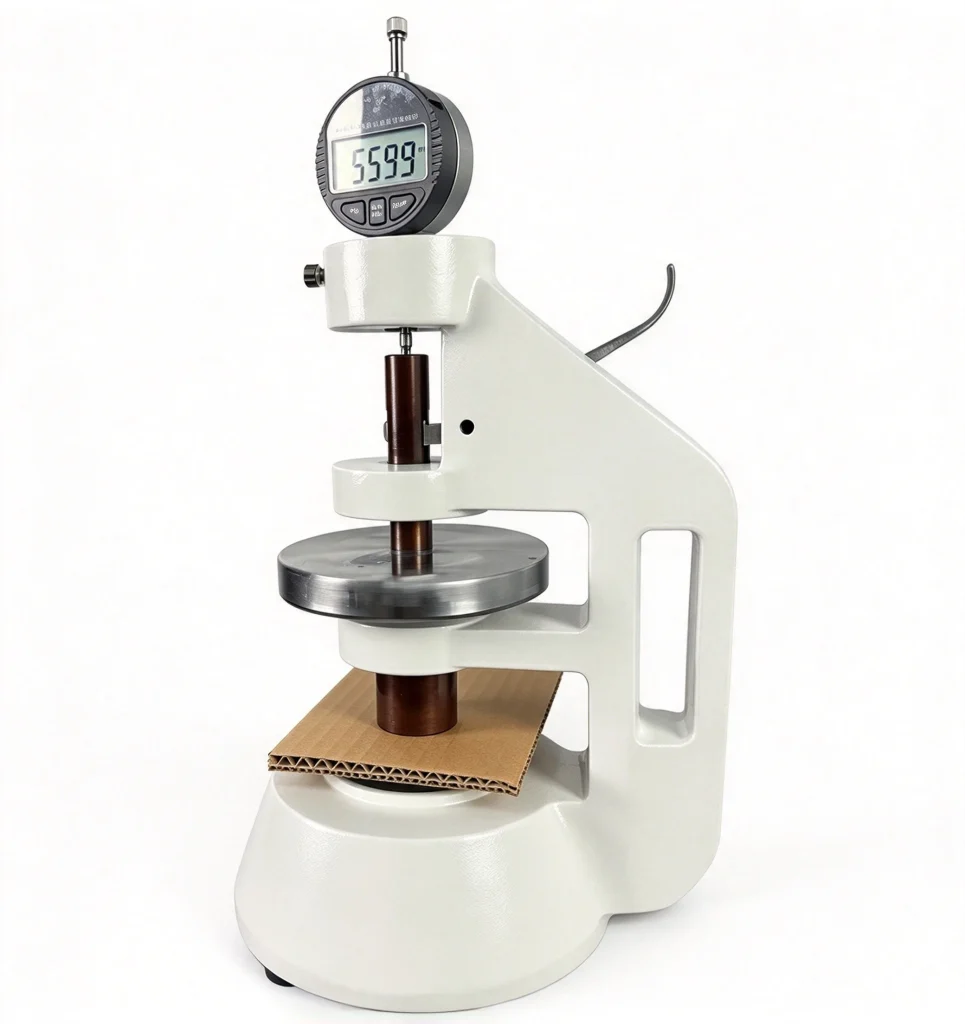
Cardboard thickness can be measured using a thickness gauge or a suitable caliper.
For reliable results, the measuring method should be appropriate for the material being tested.
7.1 Tools for Measuring Thickness
Common measuring tools include:
- Digital thickness gauge: Designed to measure the thickness of paper, paperboard, and corrugated board with controlled measuring pressure.
- Digital caliper: Useful for checking general dimensions, although measuring pressure can compress softer corrugated structures and affect the reading.
- Paper thickness tester: Used in paper and paperboard quality control to measure thickness under specified test conditions.
For quality inspection, a dedicated thickness gauge is generally preferable because its measuring pressure and contact area can be controlled.
7.2 Steps to Measure Cardboard Thickness
- Prepare a clean, flat sample of the cardboard.
- Make sure the sample is not folded, crushed, or visibly damaged.
- Place the sample between the measuring surfaces of the thickness gauge.
- Allow the measuring head to apply its specified pressure.
- Record the thickness reading.
- Repeat the measurement at several different positions on the sample.
- Calculate the average thickness if multiple readings are required.
For corrugated board, avoid measuring directly on damaged or heavily compressed areas, as these can produce misleading results.
7.3 Why Can Cardboard Thickness Measurements Differ?
Different thickness readings do not always indicate a manufacturing defect.
Variations can result from:
- Differences in paper grammage and paper thickness.
- Corrugator pressure and operating conditions.
- Moisture content and storage environment.
- Compression of the fluted structure during measurement.
- Differences in measuring equipment and test pressure.
When thickness is a critical purchasing requirement, the buyer and supplier should agree on the measurement method, sampling procedure, and acceptable tolerance before production.
8. How to Choose the Right Cardboard Thickness for Your Packaging
The correct cardboard thickness depends on the packaging application. Choosing the thickest available board is not always the most economical or practical solution.
Consider the following factors when selecting a material.
8.1 Product Weight and Size
Heavy products generally require stronger packaging materials and a box structure capable of supporting the load.
Large products may also need greater board rigidity to reduce deformation during handling and transportation.
8.2 Transportation and Stacking Requirements
Packaging for long-distance transportation or warehouse stacking may require higher compression resistance.
For these applications, double-wall or triple-wall corrugated board may be considered, depending on the product weight, box dimensions, stacking height, and transport conditions.
8.3 Cushioning and Protection
Products that are fragile or sensitive to impact may require packaging with suitable cushioning characteristics.
Larger flute profiles can provide more space for cushioning, but the final protection also depends on the packaging design, internal inserts, and the way the product is secured inside the box.
8.4 Printing Requirements
If the packaging requires detailed printing, the flute profile and outer linerboard quality should be considered.
B flute and E flute are often selected for printed corrugated cartons because they provide relatively flat surfaces. The choice also depends on the printing process, artwork requirements, and board quality.
8.5 Production and Packaging Cost
A thicker or heavier board generally uses more material, which can increase packaging costs and transportation weight.
The goal is to select a board that meets the required protection and production standards without using unnecessary material.
For example, a lightweight retail carton may not need the same construction as an export carton carrying heavy industrial products.
9. How Does Cardboard Thickness Affect Converting and Carton Production?
Cardboard thickness is not only a packaging material specification. It also affects the processing conditions and machine configuration required during carton production.
When a carton manufacturer selects a corrugated board construction, the converting equipment must be suitable for the board’s thickness, rigidity, and flute structure.
9.1 Printing and Slotting
Thicker corrugated board may require suitable machine settings to ensure stable feeding and consistent printing.
The machine’s feeding system, printing pressure, anilox configuration, and other operating conditions should be adjusted according to the board type and production requirements.
For fine printing, the outer liner quality and flute profile are also important.
9.2 Die Cutting and Creasing
Board thickness affects the pressure required for creasing and die cutting.
If the pressure is too high or too low, the finished carton may have crushed flutes, poor creasing, incomplete cutting, or other quality problems.
The die, creasing rules, cutting pressure, and machine settings should therefore be selected according to the board construction and thickness.
9.3 Folding and Gluing
Thicker corrugated board can have greater bending resistance, which may affect folding performance and the finished box shape.
The folding section, glue application, and compression section should be suitable for the board thickness and carton structure.
9.4 Corrugator Line Configuration
A corrugator line must be configured to produce the required board constructions and flute combinations.
The working width, production speed, paper handling system, single facer, glue unit, heating section, slitter-scorer, and cut-off system all need to match the factory’s production requirements.
For manufacturers producing different types of corrugated board, the ability to change flute combinations and paper grades is an important consideration when selecting a corrugator line.
10. Frequently Asked Questions About Cardboard Thickness
10.1 How Thick Is Standard Cardboard?
There is no single thickness that applies to all cardboard.
For corrugated packaging, typical finished thicknesses vary by construction and flute profile. For example, single-wall C flute is commonly around 3.5–4.5 mm, while BC double-wall board is around 5.90–6.80 mm in the reference ranges provided in this guide.
Solid paperboard and chipboard have different thickness specifications, often expressed in millimeters or points.
The correct thickness depends on the packaging application and performance requirements.
10.2 How Thick Is Corrugated Cardboard?
Corrugated cardboard thickness depends on the number of fluted layers and the flute profiles used.
As a general reference:
- Single-wall corrugated board: approximately 1.0–5.5 mm, depending on the flute type.
- Double-wall corrugated board: approximately 2.2–10.0 mm, depending on the flute combination.
- Triple-wall corrugated board: approximately 7.0–15.0 mm, depending on the flute combination.
Single-face corrugated board has a different structure, with one linerboard and one exposed fluted medium. Its thickness depends on the flute profile and linerboard.
These are reference ranges, not fixed specifications for every corrugated board manufacturer.
10.3 What Is the Thickness of E-Flute Cardboard?
E-flute corrugated cardboard is typically around 1.5–2.0 mm thick as a finished single-wall board.
It is commonly used for retail packaging, e-commerce cartons, and printed packaging where a relatively thin board and finer surface are required.
Actual thickness depends on the paper grades and manufacturing conditions.
10.4 What Is the Difference Between Single-Wall and Double-Wall Cardboard?
Single-wall corrugated board has three paper layers: two liners and one fluted medium.
Double-wall corrugated board has five paper layers: three liners and two fluted mediums.
Double-wall board is generally thicker and may provide greater rigidity and protection, depending on its flute combination and paper grades.
10.5 What Is Single-Face Corrugated Board?
Single-face corrugated board is a two-ply material consisting of one flat linerboard and one fluted medium.
One side is flat, while the other side has exposed flutes. It is commonly supplied in rolls or sheets and used for wrapping, cushioning, protective lining, and edge protection rather than as a complete carton wall.
10.6 Is Chipboard the Same as Corrugated Cardboard?
No.
Chipboard, also known as greyboard, is a solid paperboard made mainly from recycled fibers. It has a compact structure without fluted layers.
Corrugated cardboard contains one or more fluted mediums bonded between flat linerboards.
Chipboard is commonly used for rigid gift boxes, book covers, and inserts, while corrugated cardboard is widely used for shipping cartons and transport packaging.
10.7 How Is Cardboard Thickness Measured?
Cardboard thickness is measured using a thickness gauge or a suitable caliper.
For more consistent quality inspection, a dedicated thickness gauge with controlled measuring pressure is recommended, especially for corrugated board, which can be compressed during measurement.
10.8 Does Higher GSM Mean Thicker Cardboard?
Not always.
GSM measures the weight of paper or board per square meter, while thickness measures the distance between its two outer surfaces.
The relationship depends on material density, fiber composition, coating, and manufacturing conditions. Two boards with the same GSM may have different thicknesses.
10.9 What Is 40 pt Chipboard in Millimeters?
40 pt chipboard is approximately 1.016 mm thick.
This conversion is based on the definition that 1 pt equals 0.001 inch and 1 inch equals 25.4 mm.
Need to Measure Cardboard Thickness or Improve Your Production?
Choosing the right cardboard thickness is only one part of maintaining packaging quality. For corrugated board manufacturers and carton producers, checking material properties and keeping production processes stable are equally important.
If you need to test the bursting strength, compression or edge crush strength, thickness, or basis weight (GSM) of paperboard and corrugated board, Jeytop can supply suitable testing instruments to help you check material properties and monitor board quality. If you are unsure which testing equipment is appropriate for your requirements, feel free to contact us to discuss your testing needs.
For manufacturers planning to establish or upgrade their production facilities, Jeytop also provides machinery for corrugated board production and carton converting, including:
- Corrugator Lines – for producing 3-ply, 5-ply and 7-ply corrugated board in different flute combinations.
- Flexo Printer Slotter Die Cutters – for printing, slotting and die-cutting corrugated sheets into carton blanks.
- Folder Gluers and Stitchers – for folding, gluing or stitching carton blanks into finished boxes.
Whether you are looking for cardboard testing equipment, a corrugator line, or carton converting machinery, our team can help you discuss suitable equipment configurations according to your production requirements.
Contact Jeytop Carton Machinery to discuss your testing requirements or packaging machinery project.
Website: https://jeytop.com/
WhatsApp: 8618833771152